Wednesday, July 17, 2019

The Four to Six Mix and the Feminisation of Church Culture

Some years ago on this blog I did a series of posts that resulted of some head counting I did at my church; my aim was to get an idea of the ratio of males to females. This little exercise was carried out on and off for about three years. I was surprised at the approximate constancy of the ratio over the period. The ratio turned out to be about 40% males to 60% females, hence I termed it the "four to six mix". The project was linked to an another theme and that I referred to as the feminisation (in the stereotypical sense of the word) of the Western church in its spiritual attitudes and culture; in particular the move to a more emotional, intuitive and  passion based church along with a drift toward an almost gnostic interpretation of the faith. (This is not true, however, of the kind of evangelicalism which strongly identifies with the reformation and majors in doctrine and "Truth" - such churches tend to eschew the emotional and experience based excesses of churches influenced by "Charismatic" culture. They also tend to be more "masculinised" in their ethos)

Anyway, the sequence of posts between June 2007 and January 2011 on this subject can be accessed using this link:


Now here's what I want to come to. Recently the 4:6 mix has surfaced again in two independent connections: The first connection is the "iknow" church management software my own church uses. The iknow software generates this  monthly report:


The 4:6 statistic here is, I assume, taken from membership numbers rather than the rota population expressed by the bar chart. This 4:6 ratio has been static for at least a year if I recall correctly. 

I now turn to the June edition of Premier Christianity magazine where we find an article entitled  Your Church Needs More Men. This article includes the statistical schematic below:


Yes, that's right, up pops the 4:6 mix again, this time presumably based on extensive church surveys. The fact that my small sample reflects this survey is,  as I have put it before, statistical "magic" which would have made Arthur Koestler proud (See "The Roots of Coincidence" Pages  26-27 and see also my book Disorder and Randomness)

One of the concerns (and this has long been a concern of mine too) of the Christianity article is the obvious implication of the statistical imbalance: Namely, that unless young church women are prepared to stay single many will not find a male partner within the confines of the Church and will have to find husbands outside the church. In fact given that a large percentage of the more senior church population have successfully paired off it follows that the gender imbalance among young people will be even more skewed than 4:6. 

Looking through my "4:6 Mix" posts I notice that Christianity magazine has published articles on the gender imbalance and the related feminisation of the church on at least six occasions: There was a spate of articles and book reviews in 2007 & 2008: Viz: July & September 2007,  February, and March 2008 and two articles in May 2008.

In my previous posts I toyed with idea that a factor strongly related to the 4:6 mix was the "feminisation" of church; that is, a cultural skew entailing a move away from stereotypically male traits and this is evidenced in the feminisation of worship. For example, quoting from my post of Feb 22nd 2008 where I quote a church leader called Carl Beech....

As for the state of worship in church with its male alienating ‘Swoon for Jesus love ins’ Beech seems to understand this as well: “Our terminology is that Jesus is our lover – press yourselves into his arms and let him embrace you”. Beech goes onto to say: “I’m very grateful for the charismatic movement, but I think we need to recast the terminology. Some of the songs which emerged in the 90s were very cathartic.” It was a lot worse than that Carl: the mid nineties was the heyday of the Toronto Blessing when, if you didn't want to be accused of resisting the Spirit, you emulated those 'in the Spirit' and got down on all fours and barked!

This is not to say that a "feminine" style of worship is wrong in itself: Also there is no necessary inference to be drawn which stereotypes genetic "males" and genetic "females" into particular roles. Some males may prefer the feminised worship and some females may prefer more masculine styles. The statistical clustering of genetic males and females around what are conventionally thought of as feminine and masculine traits is going to be a cloudy affair subject to many exceptions. The problem, however, arises when there is an imbalance of culture  that alienates a section of the congregation.

To be frank the premium placed on a soppy "swoon for Jesus" gnosticism in some Christian quarters alienates me as it does other males. There have been some gallant moves in an attempt to create events that cater for a more male orientated "laddish" culture (such as the 4M movement). This is good and gets full marks as a nice try but what little I've seen of these events suggest to me that the epiphanies of "Jesus gnosis" are still regarded as the acme of Christian experience. While this situation persists the statistics will remain the same. 

It is probably not as simple as a trend toward a uniform feminisation; rather it may actually be a  polarisation between hyper-feminisation and hyper-masculinisation with the latter evidenced by a dominating male leadership which on occasion can be a mix of patriarchary, authoritarianism, and bullying, all of which chimes well with fundamentalism and is a complementary fit with a feminised, obedient and compliant church membership.  My current guess is that such is the reaction of church communities to cultural stress and marginalisation in a changing world. 


STOP PRESS:
Talking about bullying leaders: The abrasive and domineering Mark Driscoll is back according to a Premier Christianity web article entitled Mark Driscoll is back but he hasn't learned his lessons.   See here. But I wonder if it's not just Driscoll who has to do some learning but also a fundagelical culture which is inclined to give such characters a free ride on its back. 

Monday, May 20, 2019

Views of Norwich From a Roof Top


A year or two ago I took some photographs of Norwich from the roof of Norwich Central Baptist Church. These photos can be seen in  this PDF.  Below I have reproduced the introduction:

***


The pictures in this album show Norwich City landscape from the vantage point of the roof of Norwich Central Baptist Church. Over the years new build has made this area increasingly residential reversing the 20th century English trend to escape the inner city. But as per most churches today, NCBC has a widely spread congregation with a catchment radius that perhaps extends up to ten miles and overlaps with the catchment areas of other church congregations. Modern changes, not least waning church attendance and modern transport, have meant that today’s churches seldom serve their local “community”.  This has lead contemporary church attenders to select a church less on the basis of vicinity than on the basis of the church culture and where they feel they can settle down and connect.

The pictures were taken about two years ago and actually capture a view that is no longer available as a consequence of the construction of flats adjacent to NCBC (The empty demolition site just prior to building can be seen in the photos).  These photographs, therefore, were taken just in time to provide evidence of a remarkable historical transition that has taken place over the centuries. They show how difficult it is to snap a general view of Norwich without including several old mediaeval churches in the frame. The density of these gothic edifices is evidence that in those days churches really were “local community” churches in the sense that they served a public that was within a stone’s throw.

I remember doing this guided tour for a group which included Americans and Australians. As they did the tour they were astonished that one only had to walk a few yards before yet another medieval church came into view. Modern conditions, however, have changed what “community” means and this presents challenges to people who are still inclined to think of community in purely geographical and parochial terms.

Monday, May 06, 2019

Bible Study: The Royal Law

Picture from: https://refreshingmanna.org/the-royal-law/


The Golden Rule of gregarious living is quoted on Wikipedia as:

The Golden Rule is the principle of treating others as one's self would wish to be treated. It is a maxim that is found in many religions and cultures.

The Biblical version of the Golden Rule, The Royal Law, is in fact more general: "Love your neighbour as yourself". This more general form doesn't impose any interpretation on just how love is to be expressed; after all, there are often big cultural & understanding differences between people and this can render just how love is to be actioned problematical. But given these differences  between people what common inter-human content can be conferred on the concept of "love"?  It might seem that what is love to one culture is, in fact, not love to another culture and vice versa. So unless there is some kind of intercultural universal which we can identify as "love" then any claim to the universality of the concept of "love" would seem to be hopelessly lost in subjective and intercultural translation.

But there is such a thing as a common humanity, independent of culture. For me the universal concept of love must be based on the commonality of conscious cognition; that is, a recognition that human cognition is accompanied by conscious feelings; e.g. joys, pleasures, pains sufferings etc. Our common humanity gives us the potential to carry out an empathetic projection which provides insight into the feelings of other people and hopefully a deep care for them; that is what universal love means.

This realisation of the common human link of conscious sentience doesn't, however, remove the fraught practical question of how love is best actioned in a world of epistemic challenges, unpredictability, cultural differences and very partial understandings of what actions best serve the long terms interests of our fellow human beings. The Royal Law doesn't directly address these practical challenges it; it is a guide line rather than a tram line. But the Royal Law is the ultimate high level command to all humanity: Love one another as I have loved you, but it is your responsibility to work out in practice exactly what that means in a social context. This is a huge challenge for beings who have issues with selfishness and epistemology. We therefore thank God that a divine plan of salvation was rolled out! Don't we need it!

As is so obviously evidenced by the numerous contrarian Christian sects and divisions, all loudly accusing one another of not following the clear commands of the Word of God to the letter ("clear" only to them, of course), the Bible is not unambiguous. The Bible does not provide a full suite of rules and regulations covering all eventualities; instead we get guide lines rather than tram lines: That, I suspect, is exactly the challenge it puts before humanity. Epistemically insecure Christian sects seek an unambiguous and narrow deterministic shape to belief and practice. This determinism does not exist in Scripture.

In any case we must never forget that the Spirit of the Law is not to be found in codes, programs and rules - these are just the outward (often transient) expressions of something which goes much deeper (See the book of Galatians). In fact there are dangers in prioritising the rule of the law over the Spirit of the Law.

My Bible study on the Royal Law can be found here:

Thursday, April 04, 2019

Roman-Saxon-Norman Norwich and St Julian.

Click to enlarge this view of Norwich as seen from the east. (North is right and south is left)

I recently spent an inspiring Saturday morning on a history walk in Norwich's King street area. The guide was Alan Gidney of Norwich Central Baptist Church. We also had with us a guide who was going to tell us about the world famous St Julian of Norwich, an anchorite whose cell is attached  to St Julian's church, a church within a stone's throw of  King street's Dragon hall; the latter being our assembly point.

Alan linked King street with the Roman road running from the northgate of Caistor Roman town  (Venta Icenorum), a fortified settlement about four miles to the south of Norwich. On the 3D Norwich map at the top of this post (Courtesy of Google) Caistor is off to the left. It is not known, said Alan, whether King street is on the line of the actual Roman road or whether it followed the line of Ber street, a street which runs roughly parallel to King street and is a little further up the Wensum valley side. Ber street and King street are both marked on my map. But in any case neither road has a good alignment with the road running from the north gate of Caistor Roman town, so presumably the road from Caistor had a kink in it at some point. Hazarding a guess: The Roman road from Caistor may have run along the east side of the River Yare until it arrived at a cross-roads near Trowse, whereupon a north west connection from the cross roads ran either to Ber Street or King street.

King Street, looking south. The front of Dragon hall can be seen in the centre distance.


The uncertainty about whether Ber street or King street is the original Roman road is expressed  in the following passage taken from this web site.

Although there is no substantial evidence of a Roman town within Norwich city walls, Venta Icenorum - Caistor St Edmund, just south of Norwich - was the focus for Roman settlement, selected for its fertile soil and good communications.

The area of modern Norwich was crossed by two major Roman roads suggesting that it was important, but not as a settlement. Evidence suggests that Holmstrete Way ran east west (modern Bishopsgate/St Benedicts) and a further Roman road ran north south along King Street or and Ber Street and then up Oak Street.

So, Oak street is also thought to be on the line of the Roman road. On my map I have marked Oak Street and also Charing Cross. Charing Cross may have been the place where the road from Venta Icenorum crossed Holmstrete.  If my map is anything to go by then Ber street has, apparently, a much better alignment with Oak Street and Charring cross than does King street. (However, Roman roads sometimes incorporated kinks in order to avoid difficult terrain, so this is no proof that Ber street is our Roman). King Street, on the other hand, has a reasonable alignment with Fye bridge (marked) to the north. In Saxon times Fye bridge was actually a ford and it therefore seems not an unreasonable conjecture that King street was, in fact, a Saxon deviation from the Roman road which made for the ford; presumably the well engineered Roman bridge that crossed the Wensum had long since decayed and fording the river was the cheapest Saxon alternative.

King street gets its name from the Saxon village of "Conesford" or "King's ford". Conesford was a village lying immediately to the south of the ford and was clustered around the point where King street was crossed by Holmestrete  On the other side of the ford lay the fortified Saxon town of Norwik (From which we get "Norwich"). Magdalen Street (marked) ran down the centre of this town, a town with a ditch and bank rampart and probably topped by a wooden palisade; it was in effect the "New Caistor".  As a fortified town Norwik had burgh status and was therefore permitted by the Saxon king to mint coins.

After the Norman conquest the centre of gravity of Norwich moved south, up and out of the Wensum valley toward the Ber Street ridge on which the Norman castle was built overlooking and dominating the Saxon villages in the Wensum valley. It may be at this point in history that King Street became the bustling inland "Port of Norwich", second only to the inland "Port of London". Although Norwich completely lost its second city status after the industrial revolution, I have early memories of it as a port for (small) sea going cargo ships, although today it is just a quay for Broad's pleasure boats.

St Julian's church is a short walk along St Julian's alley, an alley which intersects with King Street just outside the famous Dragon Hall. Dragon Hall was constructed in 1427 by the wealthy merchant Robert Toppes who made his money buying and selling with continental Europe. The feudal system introduced by the Normans had run about 300 years when St Julian was born in 1342 (She died sometime after 1416). But in the latter half of the fourteenth century the feudal order was under the hammer as history was in the process of making a transition. In consequence St Julian's life covers some significant times and dates. Viz:

* The Black death 1349 (England)
* The Peasant's revolt 1381
* The mid 14th century rise of John Wycliffe's Lollard's many of who were burnt at Lollard's pit a short way upstream at from Dragon hall. They were in effect pre-reformation reformers and were considered a danger by Roman Catholic authorities.
* The Canterbury tales 1387 - 1400
* The rise of the middle classes: e.g. Robert Toppes 1400-1467 who built Dragon hall in 1427

It is a reasonable conjecture that all the dates I have listed after 1349 have their roots in the effects of the Black Death, the plague which resulted in a 40% reduction in the population and consequently left many feudal agricultural strips unfarmed. Peasant tenants moved into the fallow land and started to make a profit and eventually bought cheap land to farm; they became the land owners often referred to as yeoman farmers, eventually to become contiguous with the gentry. They were the beginnings of the up and coming middle classes who in due course became rich and influential. English social mobility had arrived. An example are the Paston family who even moved into Caister Castle on the coast north of Gt.Yarmouth (not to be confused with Caistor Roman Town). Ever since those times the rich middle classes have had a tendency to ape the English aristocracy if they could.

The power of the feudal aristocracy whose wealth lay in their unquestioned ownership of farm land (the source of medieval wealth) was weakened by the Black death. The Black death lead to a lack of peasants to till the land and this in turn made land a buyer's market. But the feudal aristocracy continued to rule as if nothing had happened. The peasantry and early middle classes weren't wearing it and revolted. But this revolt was premature; the aristocracy were still very powerful and it took at least another three centuries before, in stages, the middle classes successfully took their place in the corridors of power. In the meantime the middle classes put their heads down and got on with the business of making money, Robert Toppes being an example.

Another connected factor in the peasants revolt may have been a subtle change in social ethos after the Black death. Evidence of this might be apparent in the Canterbury tales where it is clear that Chaucer was pondering carefully the meaning of social class. After all, the Black death was no respecter of persons; it was proof that all humanity was equal under God, although it should have been noticed that this equality was implicit in scripture from day one. Just before his execution in 1649 Charles I declared his belief in the royal blood line's divine right to rule. Charles I's execution is therefore symbolic of the death of the concept of an  aristocracy with a God given right to sovereignty.

The entrance to Julian's cell.: A Norman arch. It therefore pre-dates St Julian by at least 200 years. Her original cell probably did not include this entrance. She may have been bricked in with openings left for communication, food, hygiene and other basic needs. 

Into this mix comes the mystic St Julian. Today King street comes over as a sleepy residential area but our guide told us that in St Julian's day it would been a busy inland port area with people coming and going. Our guide also hinted that St Julian may have chosen this area because she felt that it was where she was most needed. After all, ports don't have a reputation for being particularly moral. Moreover, if the Canterbury tales are anything to go by we can imagine that street level culture here was pretty raw! (as it always has been I suppose!) So St Julian had her work cut out! Unlike the Lollards, however, St Julian didn't see herself as challenging the Roman Catholic church; a church that was in actual fact in much need of reform and challenge. But St Julian's theology was not entirely in keeping with that church. One of her doctrinal novelties was her stress on the motherly feminine aspect of God and Christ, a role reserved in Catholic thought for the Virgin Mary. But St Julian didn't go out of her way to rock the boat and in those days she was still a relatively small fish and could be safely be ignored. As for the Lollard's, at first the secular authorities tolerated and even protected them, but when they became linked to the peasant's revolt they lost this protection and many were burnt at the stake. Like the peasant's revolt the Lollard movement was premature; times were not yet ripe for a big change.

Standing in St Julian's cell for me was reminiscent of my visit to the Church of the Holy Sepulchre in Old Jerusalem. In both locations little or nothing remains of their original aspect making it difficult to make an imaginative connection with the past. Moreover, in my particular case picking up holy vibes is simply not one of my strengths. This fairly plain, clean, smooth, minimalist white washed cell was not going introduce me to a meditative mindfulness; not that much else has a chance of doing that either! A commemorative board just outside the cell says "In this holy place we can almost hear St Julian saying...so & so." Well, I didn't hear her! None of this is to say, however, that many people don't meet with God in the midst of contemplative silence.


And now to modern times: The St Julian controversy

St Julian's teaching. Traditional reformists will hate it.  Needless to say after a quick search on the Web I found....!


In reformation England St Julian's writings were rescued and hidden; she was after all a Roman Catholic Saint. But her writings eventually resurfaced and became popular in the West, perhaps on the back of a resurgent Romanticism. However, traditional "logos" based protestant believers who strongly identify with the reformation will find her writings at best wanting and at worst heretical. For example the following typifies a heavily reformist reaction to St Julian:


.....nowhere in Scripture are we taught “the Trinity is our Mother,” or that Jesus—the unique Son of God—is our “true Mother,” and we’re certainly not taught, “All shall be well.” The late Dr. Walter Martin, a very well-respected evangelical apologist, was correct when he said: The vast majority of mankind; will not make it [to salvation], because they simply will not repent. And if you don’t think these people are lost; then why in the world are you even bothering to call yourself a Christian. Study mysticism, as I have, and you’ll see a common thread of universalism within it.

In closing this subject, for now, Julian of Norwich falls right in lock-step with classic mysticism of all stripes with its panentheism (all in God), pelagianism (true self, which is sinless), “a spark of the divine” where, in contradistinction to Scripture, God already dwells within all of mankind and concluding with Julian’s belief in a universal salvation.
(See http://apprising.org/2010/05/09/setting-the-record-straight-on-julian-of-norwich/)

With their tendency toward an unimaginative and stark factualism fundamentalists are often found arguing over metaphors that they interpret literally. It is certainly true that some metaphors are better than others, but if you are a literalist what should be a discussion on merit and appropriateness becomes a black vs. white battle of truth vs. falsehood, a fight between good and evil, thus releasing huge passions, emotions and acrimony. As they diligently search the Bible for "theological algorithms" which provide exact rules giving unambiguous guidance about belief and practice, it is no surprise that a book which often uses language connotationally should cause fundamentalists to fall out with one another very acrimoniously over issues which should be treated as a question of nuances of meaning. An example of such a fall-out is the council of Chalceden (451), a council attempting to settle the contention between Nestorius and Cyril over the nature of the Trinity. It represents a timeless theological fracas caused by inflexible literalist thought. Prime suspect as to the root of the cognitive dissonance at Chalceden is the concept of "hypostasis" or "substance", terms which are clearly metaphors derived from the material world and applied literally and uncritically to the Godhead. It is no surprise that the black vs white fundamentalist mind will instinctively recoil from the sometimes woolly & sloppy language used by the Christian mystic.

One can repent, believe in the Lord Jesus and receive the gift of adoption from the Father and yet in my experience what chiefly characterises fundamentalist believers is that in practice they understand "repentance" in terms of affiliating oneself to their culture's specific rendition of Christianity; all other contrary Christian cultures are likely regarded as simply unrepentant. Close approximations to the Gospel can be found among Jehovah's Witnesses and yet one knows that they too are likely to consider anyone who does not connect with their holy remnant as unrepentant and therefore non-christian, no matter how emphatic one is about receiving the Gospel. For one quickly finds that in the eyes of fundamentalist Christians of all types (and this includes JWs), salvation is practically conditional upon the acceptance of their subculture as exclusive. Keeping fundamentalists at arm's length (A policy I actually advocate) is, to the fundamentalist mind, tantamount to a ticket to hell; see here, here and here. Expressions of the acceptance of the Gospel outside their culture are all but worthless to them. But having said that I can no more defend fundamentalist reformers than I can Christian mystics who err on the side of gnosticism and like their strict reformist siblings also regard those beyond their "enlightened" culture as of an inferior spirituality. 

The reformation brought an end to the Roman Catholic monopoly on Latin Christianity. Subsequently, in the West God no longer had all his apples in one basket where they could all go bad together. But human nature remained the same and those Protestants too enamoured of the divine authority of their opinions, following medieval  Roman Catholicism, believed there remained only one basket - their's!*


Addendum 15/04/2019
https://www.networknorwich.co.uk/Articles/546301/Network_Norwich_and_Norfolk/Resources/Events/_Julian_of_Norwich_celebrated_with_weekend.aspx

Footnote:
*As has become so apparent in my Creation researches evangelical Protestants are very tempted by a dualist world view, a view where God's creative power is instinctively distinguished over and against the profane "hypostasis" of matter; shades of gnosticism haunt many dark corners of Christian culture. And yet it is the sovereign transcendent God who has created the cosmic miracle of space & time and whose omnipresent  immanence sustains it and continues to create.

Tuesday, December 11, 2018

Themed Bible Study: Chaoskampf.


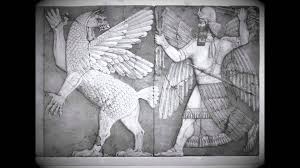
In the above Babylonian relief we see Tiamat, the personification of chaos, being defeated by the god Marduk. Here an act of  creation is represented as a struggle against chaos or chaoskampf. According to Wiki:

In the second [part of the] Chaoskampf  [myth] Tiamat is considered the monstrous embodiment of primordial chaos. Some sources identify her with images of a sea serpent or dragon.

This Babylonian creation myth has points of contact with the Biblical themes of chaos, Satan and the serpent. In the Bible similar ideas of Divine creation vs the forces of anti-creation can be found. Human sin and Satan put the self first disrupting cooperation and harmony thereby contributing to the abyssal deep of chaos, the domain of the Leviathan. 

My recent Bible study on these themes can be found here:

Saturday, September 15, 2018

Another church for my “beetle collection”.


Catalogue without boundaries: Some of the species of The Open Gospel

Recently I was asked by a friend if I would like to visit the Sunday service of a church in Norwich. He felt that this church needed some investigation. So, one Sunday he and another friend found ourselves at the morning service of “Servant’s Church”. The report of this visit (which I sent to both friends) can be found here.
Servant’s Church is part of the Calvary Chapel network of churches. This network has its origins in the Jesus Movement of the 1960s and the vision of charismatic leader Chuck Smith. It follows a pattern found among some other fellowships in Norwich: Viz; a single founding patriarch and a mentoring organisation with its centre of gravity in America. A similar pattern can be seen in the Potters House church, The Living Stream Ministry fellowships, Bethel Church, Vineyard, the Jehovah’s Witnesses and the Mormons. All these brand-named versions of Christianity have at least one affiliated fellowship in Norwich. To these churches we can add a miscellany of sectarian fellowships with origins closer to home such as the Plymouth Brethren, Closed Brethren, Strict & Particular Baptists, the Jesus Army, Reformed churches and reformo-charismatic. All these groups tend to view themselves as distinct from and superior to the more traditional protestant groupings (e.g. the Church of England, Methodists, Baptist Union, Salvation Army, United Reformed, Assemblies of God, Elim, the FIEC, and the Open brethren) and also superior to the newer mainstream charismatic churches (e.g. New Frontiers, Hillsong and Alive church). However, traces of sectarianism and fundamentalism, to a greater or lesser extent, can even be found among mainstream churches.

I don’t think Norwich is unusual in having such a bewildering array of protestant factions on top of its more mainstream groupings. Moreover, their number has been increased by the relatively recent appearance of several black (immigrant) churches. I have never attempted to formally catalogue all these fellowships/churches/groups/affiliations/congregations/assemblies. I have only succeeded in listing some of them simply because they have, for one reason or another, come to my attention; I haven't gone out looking for them, they have simply drifted into my line of sight. For example, I didn’t know about Servant’s church until my friend brought them to my attention. I have a feeling that I don’t know the half of it: Consider, for example, what I referred to as the “Car park” sect; they popped up out of the blue when they placed tracts on all the cars in the Norwich Central Baptist Church car park. Up until that moment they were completely unknown to me*1. Cataloguing churches is like cataloguing beetles: Creating an exhaustive catalogue of these congregations along with pithy descriptions summing up what they are about would require more time than I am able to give. Many of them, needless to say, consider themselves as the one and only exclusive model to follow if you want to know how to do church properly!

During the service at Servants I spotted someone I had become acquainted to in another connection and this gave me the opportunity to catch up with him and find out what he thought of his chosen fellowship. To disguise his identity in my report I have called him “Charlie Neblus”.

Footnote
*1 I must be cautious though. New sects tend to disguise their sectarian agenda and shun any badging brand names, names which readily identify who they are and their origins (see my report for suggested reasons why). Therefore sometimes it is possible to think one has stumbled on a new sect when in fact it is a sect one is already familiar with.

Tuesday, June 19, 2018

Bible Study and The Mechanism of Mind.

The mechanism of mind: So complex that it's beyond self-understanding? See here


It's undoubtedly true to say that one best learns about the highways and byways of the Bible through thorough personal study and even more so if one is preparing to lead a Bible study group; the latter rightly requires the gathering of lot of back up and contextual information for potential reference. This information, although much of which will not be used in the study group, nevertheless helps resource one's mind, either to be boiled down to something significant or later used as a vital cognitive link at some stage. The mind, needless to say, is a complex mechanism, perhaps well beyond its own self understanding and its creative abilities probably result of its non-linearity which introduces all but unrepeatable sequences of thought. There is only one power that is sovereign over such complexity, and that is God himself. 

Recently I lead a house group studying the second half of John 1. My study notes can be picked up using the link below. In some ways this study adds to the backlog of my never-to-be-finished dream projects:This is what the start of a complete study of John's Gospel would look like if I ever had the time and privilege to do the full series on John's Gospel. But given a mix of intellectual pressures, absence of opportunity and today's existential-crisis oriented spiritual values which majors in the esoteric "encounter" as the linchpin of faith, I think that's a project which is not to be!


John 1 Study Link

Tuesday, October 03, 2017

Lessons from the Minor Prophets


I've being leading a Bible study series on the Minor Prophets and below I've published links to the study notes I have compiled. 

Core Christianity, when I eventually understood it, was a revelation; it was as if a mist had gone from my eyes. I experienced that turn-about face which many converts know; namely, that salvation isn't about us taking the initiative and winning our stripes but rather the initiative is on God's part: Here's Romans 8:15-17

15: The Spirit you received does not make you slaves, so that you live in fear again; rather, the Spirit you received brought about your adoption to sonship. And by him we cry, “Abba Father.” 16 The Spirit himself testifies with our spirit that we are God’s children. 17 Now if we are children, then we are heirs—heirs of God and co-heirs with Christ, if indeed we share in his sufferings in order that we may also share in his glory.

The metaphor of adoption is a good one, particularly given the Roman culture pervading the Middle East at that time: Favoured slaves, on the behest of their masters, were sometimes adopted into their master's family thereby receiving all the rights of sons and daughters. Hence much of the connotational content  in the above passage is lost on us today.

Christianity is less something you do than it is something that is done to you on the initiative of God. For countless years the religious paradigm has been that the faithful must engage in the superstitious fetishes found in practice, belief and ritual in order to appease deity and make right the contract between God and (wo)man. But it's the other way round; it is primarily all about what God has done and not what (wo)man has done; all we need do is agree to partake of the new contract.  Wanting to become a Christian and wishing to lead a (re)new(ed) life under adoption is all that is needed to become a Christian. There then remains the question of our acceptance/adoption by God - but we know what the answer is to that. After that the details, the experiences, the formulaic doctrinal expressions and interpretations vary and are often arguable.

For many years humans have tried to fix the human-divine interface by means of tedious rule driven minutiae of practice, practice that amounts to a form of ritualistic magico-manipulation. But the interface remains broken until the psycho-spiritual engine which drives it is fixed and only God can do that. 

But let me add a circumspect rider at this point. I have met numerous Christians with a sectarian bent who will insist on imposing their proprietary facade of belief and practice on others. And if that facade doesn't graft those others are thought of as at best inferior Christians and at worst heretical blasphemers. I have to confess that there is more than one argument for the untruth of Christianity and these sectarian reactionaries are certainly one of them!

However, as one reads the minor prophets one realizes that the foregoing considerations are very old themes. These prophets understood that inner spirituality could not be fixed simply via better religious and magico-ritualistic window dressing and one of their main laments was that Judah and Israel did not understand this. Get the engine fixed and the interface will look after itself.
.
Introduction

Amos

Jonah

Hosea

Micah

Nahum

Tuesday, January 24, 2017

Church, Social Networks and Community

The contemporary Western Church faces many challenges. One of them, frequently mentioned in my blogs, is its gradual cultural marginalization. Since the 1960s this marginalization has favoured a reactionary resurgence in Christian fundamentalism and gnosticism. But there is a more subtle challenge which impedes the formation of successful well integrated church communities, a challenge brought about by modern social conditions. I don't think I would have become aware of this problem without being a member of a Church and also being acutely aware of the fundamentalist and gnostic fanaticism dividing some parts of Christendom; the latter is in part a reaction to the problems of group identification as community ties have been weakened by modern conditions, thereby favouring extremist responses. (See also here)

A community, by definition, is a group of people who are networked together via mutual social relations; it is these relations which define "membership" of the community and convey a sense of belonging. A person who is well connected to one member of the group will also likely have social connections with other members of the group. A strong community is a concentrated network of these mutual social relations. But to form these mutual relationships people need get to know one another and relate to one another in ways that make a community a community. These relationships don't happen suddenly; they need to be worked at and built up. To do this requires a variety of resources such as time, human social aptitude and perhaps a knowledge of a shared history and shared explanatory narratives, all of which ultimately lead to group identification. Each link between people in a social network is an implicit investment in time and the expenditure of mental processing power dedicated toward building social relations. But human beings are finite entities and therefore human mental, sensory, contact opportunities and temporal resources are limited. The upshot is that each person in a social network can only support a certain number of social links before their finite temporal and mental resources maxes out. If the average strength of a social link is measured in terms of the effective resources it consumes and is represented by the quantity and the number of links an average person maintains in a social network is represented by N then finite human resources will imply some kind of conservation law which limits human social potential. We might therefore conjecture a conservation relationship such as:

 R x N < some constant
Inequality 1

From a relationship of this type it becomes apparent that at the limit any one person can only increase his or her value of N at the expense of the strength of the social linkage, R. For example, a person who has mutual social connections with many, many people will concomitantly have a lower average linkage strength R. Conversely, a stronger average linkage implies fewer relationships.

Of course, relationships will not all be of the same strength. Any one person will have layers of social links of varying strength. The first and strongest layer will probably be family followed by close friends, other friends and then acquaintances etc. At the periphery of a person's social network there will be relationships where people only know one another by sight. In effect a persons relationship cluster thins out until at the edges it fades all together. In a small socially well knit town everyone will at the very least recognize everyone else by sight. But resource limits on human mental, contact opportunities and temporal powers will no doubt mean that there is some threshold (perhaps a population of a few thousand) when the power of an individual to at least recognize everyone fades out to nothing. Anonymity starts to become a factor in town life and this will have a bearing on the social cohesion of the community

In the past there would have been a strong correlation of community networks with spatial relations; those people you knew best were likely to be closest to you spatially and as a rough rule the further you got from your locale the weaker your social links. Towns were much smaller than they are today and travel and communication were primitive. The people you networked with were by and large in your vicinity. Moreover, it is likely that your family, your work colleagues, your neighbors and your church were groups with considerable social overlap. Thus a group of people related by spatial vicinity were, to a good approximation, also a community - that is, they were socially related as well as spatially related. Consequently, the resource burden of getting to know church people was less than it is today because your church may well have contained many of the same people who were your work colleagues, family and neighbours; this would undoubtedly have helped reduce the networking resource burden of church fellowship.

But conditions today are likely to be very different. Changes in travel technology, communication, working conditions, social ethos, and the size of towns etc have brought an end to the old parallels between spatial and social networks. The community experience has been fragmented: Viz: The social networks of family, friends, work colleagues, churches and neighbors have little or no overlap and constitute separate communities. The break up of a local self-sufficient industry in favour of national and international industry and the consequent need to move to a place of work has meant that family members often live far apart and thus are disconnected with church, work and neighbourhood communities. Travel from dormitory towns to work has disconnected one's work community from one's neighborhood community. In big cities Christians travel several miles to the church with an ethos & culture which suites them. Consequently the so-called "local church" with its catchment area taken from a local community is no longer meaningful.

The one-time inter-connecting overlap between one's family, neighborhood, work community, and church is now largely absent, especially in large cities and conurbations. Thus, any one person will be a player in several otherwise disconnected community groups. Work colleagues, family, the neighborhood, hobby group and church will likely all be separate social networks with little or no connection. This lack of overlap, needless to say, will put a strain on those limited human resources needed for social networking. Church community life in particular suffers. Churches may only meet on Sundays with perhaps the odd mid-week meeting; this stresses those critical human resources which relationship-making necessarily consumes, especially time and contact opportunity. In fact church people may well form stronger social links with work colleagues than they do church members simply because they spend more time with the former. We must also add to the contemporary mix the addition of online communities - people now spend a lot of time in web forums and social media with people they don't meet face to face, This spreads those limited  human social networking resources even more thinly. Church communities thus face competing claims for social networking resources. Those competing claims have come to the fore in modern times. But it's not just church; go into a modern residential area and it is quite likely that it is no longer a community in the old fashioned sense. The social networking between neighbors which once existed are under stress because work, family, locality and church have much less overlap than they once did. Neighbors may well try to be spatial neighbors but they face the same challenges that churches face in trying to serve the competing demands of all those separate and disconnected social networks. Identification with one's "natural community" can become a problem.

The upshot of all this is that modern churches may be quite loose associations of people. Sectarian and cultic Christianity addresses this problem by maximizing the networking time between their members and instilling a strong sense of belonging, identity and obligation to the status quo using guilt and fear; one's standing before God is called into question if your social networking isn't up to scratch; if not you may be categorized as one or more of a compromiser, a heretic or an apostate. For example, the Watchtower organisation discourages its young people from attending colleges as that will detract from their time spent studying with other Jehovah's Witnesses in the local kingdom halls. Also, as a means of spiritual intimidation character defamation is practiced by the Watchtower on those who fall short of expectation.  This is a tactic common  to fundamentalists in general.

 Another sectarian solution to modern community challenges is to mystify the nature of church social networks. This is achieved via the gnostic gambit, a solution which claims that gnostic initiation is a rite of passage into a sacred network that can't be seen or managed visibly, but neither can it be revoked without threat of divine displeasure. However, observation of sectarian gnostic Christianity generally shows highly partisan and schismatic behavior between different gnostic sects; evidence that the gnostic mystification of human relations is a very human attempt to cajole a belief in the presence of a super-spiritual social cohesion, when in fact no real cohesion beyond that implicit in Inequality 1 is actually present. Further observations of gnostic fellowships shows that there is no gnostic short cut to human social networking and that the real cost of social networking is implicit in the same inequality.

Non-authoritarian, non-fundamentalist churches can't, by definition, enforce community upon their congregations. They therefore have few options but to be simply conscious of the fellowship stresses that modern life places on their community and cope with it as best they can. Getting to know people brings understanding of their motives, problems, and personalities thereby giving greater insight into their behavior. But as we've seen, the modern Sundays only church (with perhaps a mid week meeting or two thrown in) means that community is only going to build slowly. Blank spaces in one's knowledge about people are easy to interpolate wrongly; if there are two ways of taking something then trepidation and fear of the unknown means that it is all too easy and all too human to take it the wrong way.

What churches need do then is to become aware of the relationship misunderstandings that so easily result when relationships are underdeveloped. Baring the pressures of cultist, sectarian, fundamentalist and gnostic social environments, relationships in the free churches will, under modern conditions, be delicate flowers. If it's any consolation at all to the free churches then it may help to understand that the problems which arise out of the loosely networked church environment parallels the problems also found in the wider society whereby people have difficulty identifying with their community and cultivating a sense of belonging - see here. In short fostering an awareness of the pitfalls of the loosely networked fellowship will help church members from being deceived by false interpolations and thinking its all down to church failure when in fact it isn't  - it's a product of modern times. If free churches realise this then members of congregations will be apt to give one another more allowance and leeway, thus removing one barrier to fellowship; namely the suspicion, fear and paranoia that so easily breeds in the silences. Although we are unlikely to be able to wind back the clock it may at least be possible to optimize fellowship under the constraints of modern times.


Interesting Links:
https://en.wikipedia.org/wiki/Fundamentalist_Church_of_Jesus_Christ_of_Latter-Day_Saints
https://www.theguardian.com/us-news/2016/apr/03/utah-fundamentalist-sect-latter-day-saints-end

Monday, January 09, 2017

NCBC Leaks No. 3

Concerning inter-Christian info-wars
The eco-movement: To the conspiracy theory touting Christian-right the above reference to "Global-citizenship" is seen as the key to the ulterior agenda of the eco-movement; namely, to unite the world under one oppressive world government!

My Norwich church has an enthusiastic eco-committee, a committee who are working hard to work out the implications of the big eco-issues for our church. Recently I received an email providing an end of year summary of all that had been achieved on the eco front by the committee. Now, although the anti-eco sentiments of the allegedly "born-again" Christian Donald Trump  were alluded to in the email I wanted to find out just how much the eco-committee appreciated the deep world view divisions which exist within the broad Christian scene. So, I sent a probing email. To be frank I had no great expectation of a reply (& didn't get one) as I don't have a strong rapport or synergy with these people in spite of supporting their work (my support is based on the sentiment that wise and economic use of resources is a good protestant business ethic!). However, as one of my favorite sayings by George Bernard Shaw goes "A life spent making mistakes is not only more honourable, but more useful than a life spent doing nothing." So being loathe to do nothing I just couldn't stand idly by and let this eco-church email pass without attempting to draw attention to what (to me) is a very pressing issue; namely, the problem of vicious Christian infighting which revolves round the eco-issue (among many others!). Here's my reply:


Dear All,

Thanks very much for the effort and work that's gone into all this. I'll do what I can to help on the premises front. Although that won't be very much, every little helps (I'm actually much more of an arm chair theorist in temperament than I am a practical man).

Now, I guess, or at least I am hoping, that some of you are aware of the sharp world-view conflicts within the Christian scene: Viz: Perhaps some of you know that across the Atlantic evangelico-fundamentalist Christianity is organically joined to the republican-ultra right; so much so, in fact, that in some quarters the eco-movement is thought of as one of Satan's many end-time deceptions (See for example christian right-wing conspiracy theorist Tim Lahaye etc).

Now, you may be aware of all this, but it might seem a long way away over the pond. However, given that social networks follow "small world" structures I'm sure that it wouldn't take much local defective work to find out where eco-scepticism and the much more strident anti-eco conspiracy theorism has close links with Norwich Churches and Belief Communities and thus concomitantly all the inevitable potential for sharp controversy and polarisation.

Just thought I'd bring this issue to the fore and add it to the mix of thought; it may have a bearing as per the allusion to Trumpkinism in the notes below.

Tim

Polarisation passion feeds. Passion polarisation breeds. Polarisation is passion's cause, for crusade and holy wars.


To be fair I suppose it is really difficult to know how to respond positively to Christian infighting, infighting which signifies fundamental world view differences (See herehere and here); after all, this infighting compromises the faith, or at least raises big questions over it; ignoring these question is the easiest response.

The holy wars between Christians are passionate, very passionate. Consider, for example, the following: 

The August 2016 edition of Premier Christianity magazine carries a news item on page 13 entitled "Trump has made a commitment to Christ, says Dr James Dobson". The article reports that Dobson  claims televangelist Paula White had 'personally led him (Trump) to Christ'. Dobson is a right-wing  Christian who, according to the article, sits on Trump's evangelical advisory board.

Let us now turn to the November 2016 edition of Premier Christianity. This edition contains an interview with Tony Campolo  a "red-letter" evangelical who supports Hilary Clinton and says "She (Clinton) wanted to use politics to do what her Christian faith had led her to do". Campolo, as an evangelical who accepts gay marriage, would likely be considered as at best a very substandard and untrustworthy Christian by the Christian right who have more tolerance towards Trump's sleaziness than they do toward the conscientious acceptance of gays. In fact, as a rule the Christian conservative right is far less accepting of the authenticity of  the faith of the 'Christian left' (such as Campolo) than the 'Christian left' is accepting of the Christian right. 

However, the point under scrutiny here is that the documentary evidence suggests that both Clinton and Trump identify as Christians. In short the Trump vs. Clinton presidential campaigns were effectively a Christian-on-Christian celebrity 'death match'. The Christian conservative right are likely to attempt to solve the paradox that this introduces by claiming that Clinton isn't a Christian - they may even claim she's demonically inspired! (See video below). To me, as an outside observer, that just doesn't ring true! Every sectarian division of Christianity between here and Salt Lake city have these exclusives opinions of their standing before God; it just smacks all too much of typically human conceits and self-deceits for me to believe any of it!

Alex Jones: You won't want for a moonshine if you believe him!

Thursday, April 21, 2016

NCBC Leaks No. 2

Concerning Fundamentalist John MacKay
Flying into the teeth of the evidence: Many fundamentalists believe that less than 6000 years ago 
people lived with carnivorous dinosaurs - except that they weren't carnivores at that time, they tell us!

I thought I had better publish the following item which I added as a comment to this post* on Network Norwich and Norfolk. It is topical because the main sanctuary of Norwich Central Baptist Church is currently being rented by John MacKay's fundamentalist Young Earth publicity and teaching organisation.

***

Yes, this article doesn’t make it clear that John MacKay is part of a fringe fundamentalist group who do not reflect the opinions of the majority of Christian scientists, evangelical and otherwise. 

But I would like to draw attention to some back ground on John MacKay. In the late 1970s John Mackay was a business partner of Ken Ham; they ran a business selling YEC literature. But according to the documentation I link to below there was a complex three way schism starting in the late 1980s triggered by the accusations MacKay made about Ken Ham’s secretary Margaret Buchanan. As a result MacKay fell out acrimoniously with his own organisation, now called Creation Ministries International (CMI). It seems that even today there is considerable rancour between CMI and MacKay. Also, CMI remain bitter about the way they were treated in the early 2000s by Ken Ham's start up, Answers in Genesis-USA. I needn’t go into details as those details are provided in the documentation I link to below. The revelations in this documentation are disquieting to say the least, quite apart from one’s opinion on Young Earth Creationism. As far as I'm aware the troubling questions surrounding this affair have never been satisfactorily cleared up

The British Centre for Science Education had a web article that is probably best read first as an introduction to the affair. My copy of it can be obtained here:


Some of the links in this article are orphaned but that doesn’t matter as I supply links to the requisite documentation below.

Creation Ministries International at the time of writing still have a web page on the affair. My copy of this page can be found here:


The original, if it is still available, can be found here:

hxxp://creation.com/regarding-john-mackay

Supporting documentation can be found at these links:


Answers in Genesis’ theme park manager, Ken Ham, has, it seems, come out on the side of MacKay. See this link:


Footnote:  * This post has gone as of 2 May so I have now linked to my own copy of the article