Showing posts with label Logos vs Pneuma. Show all posts

Friday, March 08, 2024

The Shifting Fortunes of the Pulpit


St Mary's Baptist Church 1811 build: The pulpit figures prominently

The above picture shows the interior of the Regency chapel of St Mary's Baptist Church in the 19th century, a building whose foundation stone was laid in 1811 by its minister Joseph Kinghorn.  What is notable about this interior is not just the overwhelming centrality of the pulpit, but that the pulpit is installed against a blank wall - well, almost blank: As if to relieve the starkness of this wall some memorial plaques have since been fixed to it. But the message is, I think, nevertheless clear: That is, it is intended one focuses on the pulpit ministry and not be distracted by extraneous details which may not be usefully edifying. 

In those days I don't think the congregation had any instrumental accompaniment to their singing as there appears to be no space in the pew packed interior for a band, although I suspect the pews running perpendicular to the congregational pews were for a choir. It was only in 1863 after some years of resistance and three years after open communion had been won in a court battle that a small organ was gingerly introduced. Ideas were on the move and the fact that the church had presumed to adorn their pulpit wall with memorials to their esteemed forbears suggests to me they were becoming aware of themselves not just as sinful ears to be harangued from the pulpit, but also as a respectable sub-culture with a proud lineage.

As if to confirm that a revolution was slowly unfolding, in 1886 the chapel underwent a lavish Victorian refurbishment (See picture below). The pulpit wall was knocked out and extended into an apse-like chancel and this was then filled with an organ and choir stalls.  In contrast to the coy introduction of the organ over twenty years earlier, the new organ was a sophisticated and grand piece of machinery. It served as a sensational centre-piece in the refurbished building, sending a signal about the wealth of the church and its social status. But the extravagant hedge of organ pipes and the richly carved surrounding polished woodwork were in danger of upstaging the pulpit. The pulpit however was still central, if rather lost in all the competing detail; unlike the Regency chapel where the pulpit stood out against the nothingness of a pallid wall.

St Mary's Baptist Church after the Victorian refurbishment of 1886 

In 1890 St Mary's Baptist Church planted a daughter church on Sayers Street in Norwich. In 1905 this new church went on to build the pseudo-Gothic pile of Dereham Road Baptist Church, serving the sprawling Victorian & Edwardian suburbs in that area. At the sharp end of Dereham Road Baptist Church we find a central organ/choir/communion table/pulpit configuration that has striking similarities with the configuration at St Mary's Baptist Church (See the picture below). Although the pulpits of both churches were now surrounded by competing details the overall impression, however, is that both churches still gloried in the pulpit and its ministry of words. 

St Mary's daughter church; Dereham Road Baptist.

Unfortunately, St Mary's elegant regency building with its rich Victorian interior was destroyed by a combination of fire in 1939 and a WWII bombing raid in 1942. But when St Mary’s congregation came to rebuild their post war church in the late 1940s and early 1950s something strange happened: The pulpit was shifted to the left of the communion table and stood in sentry at the mouth of a well-defined chancel; a configuration found in many C of E and Catholic churches. The pulpit was no longer vying for central attention as in days of old. Instead, we find only the communion table at the centre.... See the picture below:

St Mary's post war rebuild.

This change may have come about because history was now telling these non-conformists they were no longer a persecuted sect, in fact quite the opposite: They had been sympathetic to the North American revolutionaries and were vocal in their opposition to slavery; history had come out on their side. Moreover, they were now respectable pillars of society and had behind them a history of knights, MPs, and successful businessmen.  They would have therefore felt themselves to be on a par with the state church. In fact, the architecture of Dereham Road Baptist Church is evidence that they were already flirting with an establishment look as far back as 1905; that contrasted with the early days when non-conformists preferred a secular classical look as opposed to the state church gothic look; in those days classical architecture help set them apart from the state church. But there may be more to it than this: After two devastatingly destructive mega-death world wars the like of which were unprecedented in all human history there may have been a sneaky feeling that no rationale articulated in words alone could do justice to the human predicament.

In times of crisis & doubt there is a tendency for human beings to find consolation in mystery and the esoteric. During the first world war protestant soldiers would often resort to Catholicism's arcane rituals of death in order to derive some comfort in the face of mortality. In the first half of the 19th Century the Catholic architect Augustus Pugin tried to revive the flagging devotion of the industrialized masses with the architectural finery and romantic mysticism of the gothic revival.

But many protestants were also starting to behave as if words were not the only experience to be had in church. In the above picture of St Mary's Baptist Church, the centrality of the communion table may signify that there was a shift away from pulpit culture toward the mystery of communion with God. But this relatively mild change was a portent of more fundamental shifts that came in the second half of the 20th century when the ministry of words was to find itself jostling with the ministry of esoteric experience. This reached a crescendo in the 1960s onwards as sublime gnostic encounters with God were regarded as the acme of Christain experience..... in fact, when I once recommended a scholarly & intellectual Bible teacher of my acquaintance, I was told that his ministry was like going back to the dark ages! At that moment I knew I was now in a culturally alien landscape to which I could contribute little. In much contemporary Christian culture faith centers around the mystical "encounter" with God. "Encounter" is now a rather hackneyed buzz word, heard everywhere in today's passion centred Christian communities; it connotes a deep mystical tryst with the divine. Not that I think there is anything wrong with ecstasies and sublime encounters with God; the trouble comes when these experiences are used as a shibboleth of an underlying authoritarian "gnostic" philosophy (See here).

Today services at St. Mary's Baptist Church (Now called Norwich Central Baptist Church) look like this.....
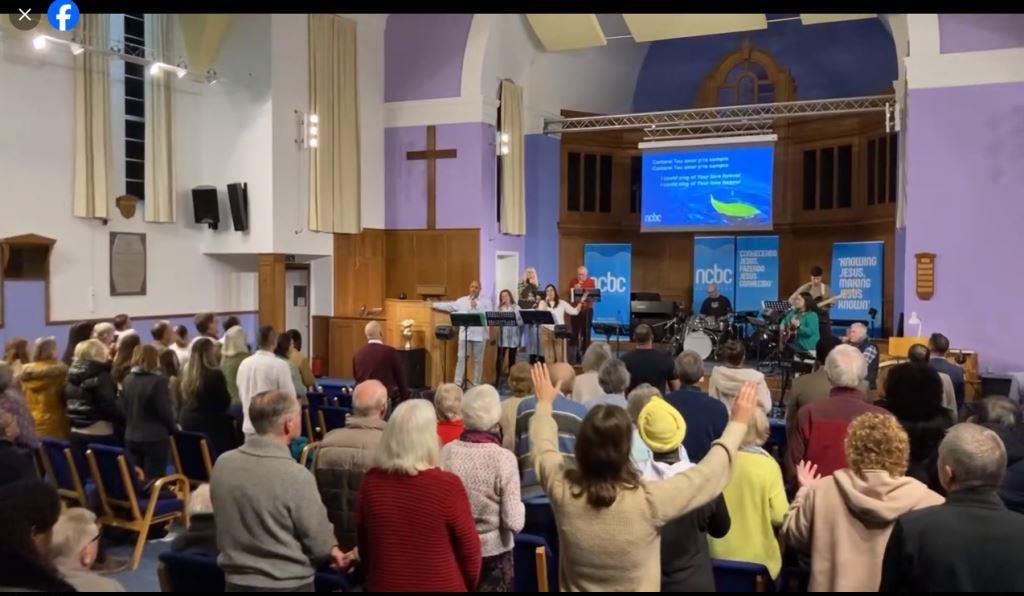
Worship today in Norwich Central Baptist Church.

The offset pulpit is now redundant and only used as a hideaway for sound equipment and other items; it no longer serves as a way to give non-conformist sermons some kind of cathedra authority; that may not be a bad thing. However, in its place one is likely to see the animated personable talking head who has plenty of personality; no longer confined to the few square feet of the pulpit they also have plenty of maneuvering room on a large stage. This stage may also be occupied by a band which is there to help the congregants lose themselves in the reverie of the worship experience, when they are not picking their way through the pith of the ministry of words. As it is at NCBC so it is with many other modern worship venues. At NCBC, however, there remains a healthy balance between Logos and Pneuma.  

My theory is that these changes in Christian culture are driven by changes in the wider society where the church no longer has an authoritative voice in that society. The story told by the church as a sense making "cosmic mythology" no longer resonates in the wider world.  I can understand that as a cultural (over) reaction to contemporary conditions (Although I, of course, beg to differ with that reaction). In this context to appear to practice some kind of pulpit-based cathedra authority may come over as presumption, even among church goers. When words cut less ice and their impact is exhausted there is a yearning for sublime encounters with the transcendent God.  This yearning has upsides and downsides; by itself it is not entirely healthy as words are needed to regulate the potential excesses of gnosis. 

***

But in spite of these profound cultural changes, we don't have to go very far to find something that harks right back to the first half of the 19th century. Across the road from Norwich Central Baptist Church is a small Strict and Particular Baptist church which calls itself "Zoar Chapel". Inside the walls of its plain unfussy exterior, we find this:

Inside Zoar Chapel just across the road from NCBC

In this small Christian dynastic cultural pocket, it is as if nothing has changed for the last two hundred years. It has a pulpit standing against a featureless wall, thus allowing nothing to upstage the ministry of words. The only concession seems to be the small organ on the right-hand side below the pulpit. Such groups jealousy guard their doctrines. Even though the congregants at the massive pile of NCBC across the road bill themselves as faithful evangelicals (a title which must nowadays be distinguished from today's North American far-right Trumpian evangelicalism) they are likely to be regarded by Zoar Chapel to be in the grip of compromise. To the members of Zoar Chapel the stasis of their practice and belief is evidence they are attuned to timeless and universal truths. They therefore pride themselves as being unaffected by the changes in modern culture which shapes the practices of Christians beyond their walls - if indeed they even think of them as Christians! 

Friday, March 03, 2023

Sermons in Stone II: Just when you thought it was safe to go back to your pew.


Dereham Road Baptist Church, Norwich: 
The subject of my monograph, "Sermons in Stone". 

 I recently published on my FB page a link to my monograph "Sermons in Stone".  As I read through it again, I realized that there was more I would have liked to have remarked on and didn't. So, something like the following will probably appear as a short postscript in a future edition. It may be a bit obscure without a knowledge of history, but it is, I believe, relevant to contemporary church life. 

***

May be in reaction to the ostentatious and austere spirituality of the puritans, the English Restoration of 1660 ushered in an architectural period when the rational and secular feel of classical styles was the preferred church architecture. This persisted until the end of the Regency, by which time the gothic revival (from 1740s onward) was making itself felt among church builders. This revival was part of the romantic movement: The romantics were a reaction to the intellectualism of the enlightenment and the machine society of industrialization. This reaction involved a reaffirmation of the mysticism of the infinite and the emergence of an idealized and nostalgic conception of the mediaeval world. (Consider for example Strawberry Hill) The romantics were trying to reconnect reality with the world of human feeling and mood.

When after 1688 the English nonconformists were free to build their own worship spaces they initially opted for clean & neat classical styles to distinguish themselves from the "semi-reformed" State Church. However, an innate human diffidence toward the outcomes of the enlightenment and the industrial revolution appears to have led to a complex reactional interplay between the rational & the romantic and the mechanical & the mystical, leaving many puzzled about where life's meaning is to be found, if indeed they believed there was such a thing as meaning and purpose. Even for non-conformists gothic styles became a way of reaffirming the overarching mystery of life.

Dereham Road Baptist Church is a left over from the late gothic revival built by protestants who in their early days would probably have reacted against such romantic architecture, perceiving it as too popish. In fact the Berean tradition from which these protestants came would likely have laid claim to the rational high ground in that they saw themselves as reading scripture unsullied by Catholic prejudices & mysticism.  But in later years, especially toward the end of the 20th century and beginning of the 21st, Protestant evangelicals appeared to be the very opposite; that is, none other than a last bastion of mystery and irrationality. By the late 20th century Protestant mysticism had moved on from the external expressions seen in gothic architecture like DRBC to the mystical internal experiences of the chaotic Charismatic revival.

Today we still see the existential tensions caused by the unsettled contentions between mystery & mechanism, between rational secularism & religious fideism, between the sense of the romantic & the stark functionality of a machine culture, between modernism & postmodernism and between the cosmic perspective and the intimacy of the inner life. These unresolved issues are endemic to the culture of the industrialized West. They are also relevant to church life because they can result in existential crises and sharp fundamental disagreements. See here for example.

As Sir Kenneth Clarke said:

We've a long rough voyage ahead of us, and I can't say how it will end because it isn't over yet. We're still the offspring of the romantic movement and still victims of the fallacies of hope. 


Sunday, January 24, 2021

Return of the Killer Pews


These pews were made for sitting and not the Charismatic Dub Step!

In 1995 I wrote a short essay entitled "Killer Pews". It was a response to a pattern of behaviour I had seen frequently in church life (and continue to see), a pattern where we find some Christians agitating for a spiritual revolution that supercharges what they regard as the rather humdrum, mediocre & unempowered work of a target church. The proposed remedy is that individuals must proactively seek an experience of "the Baptism of the Spirit". Given that many people in the church may already lay claim to having had the Baptism of the Spirit, sometimes more generic and vague terms such as the touch of God, an encounter with God or an infilling may be used. However, when one analyses what is actually being promoted one finds that it has less to do with spiritual experience per se than it has in trying to cast spiritual renewal into a quasi-gnostic philosophical mold by asserting a sharp distinction between the initiates and non-initiates of  some kind of inner spiritual light. As is so often the case when the target church fails to respond to the revivalist challenge it is then put down to "resisting the Spirit".

I must caution at this point that I am in no way presuming to put an unqualified denial on anyone's personal Christian experience or any epiphany they may have which takes them to a new level (which they may rightly or wrongly call the Baptism of the Spirit), anymore than I would expect them to cast doubt on my own very proprietary experience; rather my criticisms are about how such experiences are being interpreted and used to promote a philosophy which perceives Christian life in dualisms: "head vs heart", "intellect vs intuition",  "reason vs faith", initiates vs non-initiates and the like.  

***

I'm currently following an online service where the challenge of moving onto a whole different plane of super-spirituality & blessing is being promulgated by the speakers of the latest sermon series. At the time of writing Killer Pews in 1995 I was seeing, and had seen, Christian experience being cast into a very similar dualist mold of initiates vs non-initiates. This philosophy can lead to a lot of hard feeling not least because the logic of its aficionados has maneuvered them into such a position that they can only see criticism as a form of resistance to the very Spirit of God. They therefore can do little but consider any challenge to their views as a very grave matter indeed. 

I have of course written a lot more on this subject since 1995, some of which can be found in the links below. Possibly at the end of this latest episode I may say something about this particular foray into "gnostic" renewal. But let me hazard what I think will be the likely outcome of this latest sermon series: By and large the preachers will hear positive noises from the people they are preaching too, but because these preachers find difficulty taking onboard the variety, broadness and depths of the human personalities they are dealing with and moreover, the variety, broadness and depths of God's work, the outcome will fall short of the new dawn they are looking for. We might end up with some very disappointed promoters who will feel as though they have been punching at very soft foam rubber. It's happened before.

http://viewsnewsandpews.blogspot.com/search/label/Dualism

http://viewsnewsandpews.blogspot.com/search/label/Fideism

http://viewsnewsandpews.blogspot.com/search/label/Mythos%20vs%20Logos

http://norwichcentralbaptistchurch.blogspot.com/search/label/Logos%20vs%20Pneuma

http://norwichcentralbaptistchurch.blogspot.com/search/label/mythos%20vs%20logos


ADDENDUM 13/02/21

More details about the underlying philosophy of the sermon series commented on above can be found here:

http://quantumnonlinearity.blogspot.com/2021/02/head-vs-heart-intellect-vs-feeling.html


ADDENDUM 

20/04/21: I post here my detailed comments on the online sermon series I refer to above: 

https://drive.google.com/file/d/1OWIjP8FdaVrRYbhBJL0M9bVR3gM2kOGd/view

Sunday, February 23, 2020

Analysing UK Church Statistics: Logos vs Pneuma


The above chart shows how church attendance in the UK, for a variety of denominations, has changed in 35 years since 1980. The general trend is obviously downwards, although it will be noted that the Pentecostal denominations and what are termed "New Churches" have increased their numbers as have the Eastern Orthodox church. Some of these church groupings may be clusters  of church cultures with only marginal commonalities: For example, "Baptist" covers churches affiliated with the Baptist Union and also the Strict and Particular Baptists. "Independents" may cover Brethren,  FIEC and various independent evangelical and reformed leaning "Free churches" (Indeed "Brethren" itself breaks down into further sub-groupings). The so-called "New Churches" probably cover various "charismatic" leaning churches such as New Frontiers, Hillsong, Vineyard, Calvary Chapel, Bethel, Potters House, Jesus Army etc.

On a couple of occasions now I have heard some church goers lauding the "New Churches" as perhaps having found the holy grail of church life, namely the spiritual secret of church growth, in so far as they seem to have bucked the trend of decaying church population. But in the absence of more information this is a long shot.  Let me explain:

 If one of the components effecting church population is an exponential decay then we will have:

Rate of decay = a constant x church population

This means that the bigger a church population is the faster it decays. If this is one of the components at work it would explain the huge drop in the large traditional church populations of Anglican, Catholic and Methodists and the relatively smaller drop in other smaller traditional churches like baptists and evangelical independents.

However, exponential decay is clearly not the only component involved: Pentecostal churches, which are of a similar size to Baptists, have increased their population whereas Baptists have dropped. Also, the "New Churches" have increased. This might suggest that they've cracked the problem of church growth were it not for the fact that they are relatively small and therefore more resilient to decay; they only need a small "trickle-in" component to more than cancel their slow rate of decay. For example, if just some people coming out of the jaded traditional churches are looking for a new exciting church scene and in consequence turn to the lower end population New Churches that may explain the growth among these churches; after all these churches tend to address today's Christian existential crises by offering the security of "spiritual intimacy" and personal epiphany, not to mention the simplicity and certainties found in their style. But even so the New Church growth is not spectacular: It's taken 35 years for this relatively small population to grow by over 100% to 160k - that's  about 2.6k per year..

It's worth noting that the tiny orthodox church (and therefore with a small decay rate) doesn't need much input from the Eastern European immigrants to buck the trend and grow by 160% in 35 years. (that equates to a mere 0.5k per year growth!)

The Pentecostals have grown by 36%; that is, by about 2.2k per year; that's lower than the per yearly growth of the New Churches. That may be a bad sign: Pentecostal traditionality may be part of the reason, but the Pentecostals are quite a bit bigger than the New Churches and so their lower growth rate may, ominously, be evidence that their greater size means that they are starting to show the underlying exponential decay component at work. If this is correct and the decay component is actually there all along in both the Pentecostal & New Churches and that they are actually partly being fed by the decay of traditional church it follows that their growth will slow down as their populations get bigger and become more vulnerable to the decay component.

This foregoing analysis is rather precarious. After all, it's a case of looking at the data and attempting to resolve out a superposition of growth/decay components in a background of a lot of random noise. But then to my mind this is no less precarious an analysis than those who look at the data and conclude that the New Churches have cracked the problem of church growth by waiting on the "spiritual revolution" and therefore the traditional churches only need drum up the same enthusiasm for this new dawn to solve their population problem. Moreover, I think we need to factor in here the pattern often shown when the church feels culturally marginalised; namely, that it tends to become more spiritually internalized and shifts from an emphasis on the articulations of "logos" to the intimacy of "pneuma"! Sometimes the latter starts to skirt the boundaries of fideism and gnositicism

My best guess is that the real problem is what that background component of exponential decay really means; that's likely to be societally systemic and there is not much we can do about it. The nub of the problem is in the culture beyond, in society at large: The spiritual revolution needs to grab the outside culture (and not just the church) and turn its nihilistic malaise on its head! When that happens churches of all sorts may be left wondering why at one time it all seemed so hard!

Friday, April 25, 2008

CHURCH IS A DRAG


The May edition of 'Christianity' Magazine has two articles on the issue that I have repeatedly raised in this blog: That of a church culture skewed toward the feminine. A point that neither article seems to grasp is that the masculine-feminine ‘spectrum’ is an abstraction defined by the clusters of traits that have varying probabilities of being associated with the more clear cut phenomenon of genetic typing. For example, physical strength is more likely (but NOT necessarily) to be found amongst males than females. Once this abstract male-female space is set up, actual genetic males and females may find themselves at different points in that space.

Given this concept of the male-female space, the fact is that churches are a niche subculture that is biased toward the feminine cluster of traits in that space. Males who demonstrate a more feminine mindset are in turn more likely to find themselves in line with church values than those with obviously extreme masculine traits. But there is one exception; the Male ‘Leadership’ patriarch is often welcomed with open arms, and finds a place in an subculture that frequently favours submissive behaviour and a dumbing down of an analytic mindset, whether that mindset belongs to a genetic male or a genetic female. See the restorationists for fine examples of patriarchy.

Both articles in 'Christianity' were written by females. One of the articles ends ironically with what to me is actually a call for the church to become even more feminine in its slant! That is, according to the article writer we should get out of the comfort zone of our safe and highly focused stereo typical roles, connect to the holy mystery of God and the mysteries of the gender gap, generally be more outgoing, relate to one another and learn from one another! Next time I go to church I think I’ll dress up in drag and act in a less focused and more scatter brained way; I might fit in better.

Friday, February 22, 2008

THE FOUR TO SIX MIX: AGAIN


‘Christianity’ magazine has run two articles (see February and March) on the disparity in the ratio of males to females in churches. Here are my comments, as promised. As I have been aware of this issue for some years (and have written about it) I’m rather disturbed that only now have I found an article airing the matter. Anyway that’s an important start – my own church remains utterly unaware of it.

The two articles cover an interview with Carl Beech Chief executive of Christian Vision for men. I’ve got to hand it to him, Beech does seem to know how to connect to men, although his take on masculinising the church is to give occasion to the issue driven laddish sporting bravado that many men enjoy and engage in. If Beech’s succeeds here then he would have done the church a service.

In my case the way of being a male is slightly different. I have never been one for the laddish culture, as I approximate closer to that male preserve of the quasi-autistic loner who focuses relentlessly on single goals - stereotypically represented in the media by the likes of ‘The hit man’, ‘the terminator’, the lone hobbyist or geek etc.

But in common with the lads it isn’t just a case of me feeling that church just isn’t getting through; in actual fact it’s more a case of that church being proactively against the masculine model and its various manifestations. In modern evangelicalism conversion is all about a personality change that seeks denial of one’s masculine traits in favor of an intuitive reverie so aptly summed up by the phrase ‘The Heart Knowledge Christian’. What church wants, as Beech puts it so well, is chatty friendly ‘small talkers’, effeminacy, wimpishness, a passive submissive imbibing of homiletic monologues on Sunday, indifference to technical gadgetary, and drivers of cutsie feminine cars instead of real manly cars. As far as masculine pursuits are concerned, Beech says that the signal from the church is ‘Stop it because it’s all really sinful’.

As for the state of worship in church with its male alienating ‘Swoon for Jesus love ins’ Beech seems to understand this as well: “Our terminology is that Jesus is our lover – press yourselves into his arms and let him embrace you”. Beech goes onto to say: “I’m very grateful for the charismatic movement, but I think we need to recast the terminology. Some of the songs which emerged in the 90s were very cathartic.” It was a lot worse than that Carl: the mid nineties was the heyday of the Toronto Blessing when, if you didn't want to be accused of resisting the Spirit, you emulated those 'in the Spirit' and got down on all fours and barked!

Not news really, but having identified the problem what do we do next? In some ways the loner like myself is much better placed than the lads; I can simply ignore all these soppy goings on and pursue my own projects. But what does jack the lad do when he can find no social outlet for his laddishness? He says: "Fuhgeddaaboutit!"

Sunday, December 02, 2007

HAVING SEX WITH GOD
Sometimes life delivers unreservedly classic film set scenarios and clichés. For example, an owl hooting just as I arrive on a dark starry night at the door of the Old ‘Haunted’ Castle where I work. Or the red cloud streaked sunset of December behind the Castle's East Wing as a gentle warm yellow glow filters out through leaded lights – so Kincaid that if it wasn’t real it would be considered naively kitsch. Well, today at church I had one of those unreal moments, too perfect, too stereotypical, and so textbook and clichéd that you’d think I had invented it.

Shortly after I walked late into the foyer on security duty the congregation struck up with one of my favourite carols ‘O Come Emmanuel’. This carol is packed with allusions and imagery taken from the texts of Old Testament history: ‘Ransom captive Israel’, ‘Lonely exile’, ‘Thou rod of Jesse’, ‘Thine advent’, ‘Key of David’, ‘Sinai’s height’, ‘In ancient times did’st give the Law’. As I listened I wondered how many of the congregation connected with a language that to be understood requires a modicum of OT scholarship. After all, this was the church where I had heard on more than one occasion a negative response to having ‘Yet another Bible study’. Anyway, as I had barely finished mulling all this over the next song started, and it turned out to be a quantum leap from the ridiculous to the sublime – no, make that ‘from the sublime to the ridiculous’.

The mind often filters, generalises and then forgets the data on which its generalisation have been made, and one is then left in doubt about the validity of the mind’s abstractions because the original protocols aren’t there to check against. Thus, my generalisation that parts of the contemporary church has abandoned erudition (whether Biblical scholarship or science) in favour of the much exalted and sought after ‘there and now’ quasi-sensual God experience or ‘God orgasm’ has sometimes felt a little off the wall. But as this new song struck up I felt vindicated. As if to emphasise the polarity of scholarship versus the ‘God orgasm’, starkly contrasting against the obscure Old Testament lyrics of ‘O come Emmanuel’ still sounding in my mind, steamy allusions to the ‘God experience’ now assaulted my ears: ‘Fill us’, ‘Passion!’, ‘Breathe within’, ‘abandoned to you’ ‘Lord have your way with us’, ‘God fall on us’ ‘More than this!’ all packed into a single song. (Note: More! More! Is an ecstatic cry one hears in some churches – I wonder if one also sometimes hears Yes! Yes! Yes!…?)
In spite of all the pretensions of prophetic insight that Charismatic Christianity has brought to churches nowadays, those churches seem so utterly unconscious of themselves!
So there you go, yet another minor adventure so pregnant with freudian meaning and insight that I'm sure I'm dreaming!

Friday, October 05, 2007

MORE MALE-FEMALE HEAD COUNTING: A CONCLUSION


Taking the average of figures I have posted on the above subject gives a 42%-58% split between males and females at NCBC services. Last Wednesday night I had the opportunity to take a peek at the list of names of people who have signed up for NCBC’s “Christianity Explored” course. I tallied up the males and females (excluding one or two foreign looking names I was unable to identify as either male or female) and arrived at 14 males against 23 females; that is a 38%-62% split. Once again we have the approximate 4:6 ratio popping out of the woodwork. What makes this result interesting is that the same value now emerges in a rather different situation to the services – namely, the take up of a course which is probably populated by a younger cross section, but nevertheless returns a similar ratio. Interestingly, and I don’t know if this means anything, I got exactly the same 38%-62% ratio in the morning service, a service that includes widows. Is this evidence of “first in last out” effect amongst women?

So what does it all mean? Well, I’ve rattled on about the feminization of Christianity, and that may be a factor, but is this bias toward the feminine part of something more general? After all, the readers of astrology columns and the members of a stage spiritualist’s audience have a female majority. Likewise, although I did no sample counting on the evening, the Benny Hinn rally in Norwich (which I endured for research reasons), looked as though it had a female majority amongst the white members of the audience. Is the female mind more likely to tune into the ‘spiritual’ than the male mind? In attempting to explain all this, my best shot at the moment is what follows.

The mind has at least two modes of working. Mode 1: It uses a series of prefabricated heuristics and algorithms. Mode 2: it is capable of actually constructing new heuristics and algorithms. Mode 1 is often loosely associated with the’ limbic’ system; it is instinctual, intuitive, emotional, inscrutable, mysterious and largely unconscious in operation apart from its end results perhaps. Its pros and cons are that it is fast in producing results, embeds much age-old wisdom, but its inflexibility makes it error prone and its inscrutability makes it difficult to correct. Mode 2 is associated with cerebral and conscious thinking. It is clearly a much more complex and difficult activity. Its disadvantages are that it is painstaking, doesn’t quickly arrive at conclusions and can be indecisive, but it is flexible, adaptable, accountable and correctable.

Now here is the rub: these two different modes can be at odds: in fact industrial society, which is largely the product of mode 2, has created conditions in which the prefabricated mental structures of the intuitive mind often feel like a fish out of water. It’s the old head verses heart cliché in another guise. Religion, which so often uses the limbic as its main resource, may find itself alienated from the products of conscious cognition. Rather than a negotiated peace between two complimentary modes of mind there is, in some religious circles, a war on, a head versus heart war. And one can see this in Christianity. Take for example these two quotes that I have culled from Christian circles:

If you always process salvation through your mind you will never enter the fuller things in your walk. You must move from a place of cognitive reasoning ability to a place where faith and belief flows through your spirit and not your head … God is beyond your logic.A softer and perhaps less objectionable version of a similar thing:

I have met many people over the years who have tried to build their faith in their minds. However the mind is based on logic and sometimes the things of God are not logical! The key, I find, is to have your faith in your heart, here needing to understand every detail is not important as all you believe in is based and surrounded by the ultimate truth that God loves you!
(Interestingly in the audience listening to speaker of the first quote I estimated a 35%-65% male-female mix) These quotes attempt to elevate the 'limbic' by heightening its inscrutable mystique and defame the cerebral by suggesting it is mundane, prosaic, earthly, dead and cold. But the fact is that both modes are human and both modes are error prone and yet at the same time both are deeply mysterious in their operation and function under Divine sovereignty. They are complimentary and they should negotiate and not be set against one another.

Now here is the second rub: the female mentality is slightly more skewed toward the limbic mind than the male mentality and hence (I submit) the 4-6 mix of males to females found in churches and other ‘spiritual’ connections. Religion often exploits the age-old limbic system. I wouldn’t want deny that revelations come via this system, but its inscrutability leaves it wide open to exploitation by charlatans and religious quacks. I would be the first admit that we need different kinds of folk in church: intuitive oracles and conscious thinkers and they should compliment one another. However, it seems that looking back at the recent history of western Christianity the swing betrayed by my male-female statistic is not just a statistic – it is thermometer indicating a swing in values toward the limbic: limbic responses are considered to be a sign of a superior spirituality. As limbic Christians have become more and more alienated from the results of a science based society whose main resource is the cerebral mode of thinking, there has been a reaction against the cerebral in favour of the intuitive, emotional, and instinctive and this reaches its extreme in Gnostic flavours of Christianity.

There is an irony here: Christians place a heavy emphasis on the role of the Holy Spirit in bringing people to faith. That’s true enough, but it seems that the Holy Spirit is not transgressing the properties of His own creation: The same subtle pressures found in the current social milieu which favour a retreat of a cross section of religious people into the inscrutable world of limbic reactions are also found amongst Christians. The limbic appeal of Christian churches, like astrology columns and spiritualist churches, is betrayed by the side effect of a skew toward female majorities. This doesn’t invalidate Christianity but it suggests that the Holy Spirit is working very much within the parameters of His own creation.

How does someone like myself fit into all this? The ‘skeptic’ Larry Moran on Sandwalk, is likely to accuse someone like myself of being a deist. In his own terms he may be right as I am inclined to stress the full range of options that the Divine has available without resort to the overtly miraculous. In defence I would have to say to Larry that with the passing of the Newtonian universe deism is a less clear cut category than it was – the day by day providence of God is seen in the vicissitudes of chaos and randomness. But of course redneck limbic Christains will have none of this: they react instinctively against any thing that goes against their instincts and they have no truck with such fine distinctions. This attitude is at once both conceit and self-deceit.

Friday, August 10, 2007

THE HYPERFEMINISED CHURCH.

After my blog on the hyperfeminised church and the subsequent head counting blogs that resulted, I was interested to read a review in the September 2007 edition of ‘Christianity’ about a book called “No More Christain Nice Guy” by Paul Coughlin. The reviewer (Tony Horsfall) says that the book contains a chapter called ‘Jesus the Bearded Woman’ and that it is a “...hardhitting call for men to rediscover their true identity, which he (the author) claims has been emasculated by radical feminism and the teaching of the church. Rather than being passive, naive and avoiding conflict, men should be proactive assertive and courageous, taking hold of the rugged side of Jesus.”

At the very least, it does seem this is not just another of my own idiosyncratic hobby-horses and that there is an issue here percieved by others. Although I wouldn’t say that I find what goes on in my own church particularly obectionable, I have to admit that I often feel its ethos fails to connect, relate, or illuminate the interests, problems, and aspirations I face in my own day-to-day living. In fact this very issue of hyperfeminisation is one of them. As far as my church is concerned the issue simply doesn’t exist. Moreover it is likely to remain outside the cognizance of the church, and the ‘prophecies’ it receives will in turn reflect its ethos. Surprise surprise!

Thursday, June 28, 2007

THE HYPER FEMINISED CHURCH


An article in the July ‘Christianity’ reports on the difficulty Christian women are having finding marriage partners because of the paucity of males in church. As a result of this article I did some head counting at last Sunday night’s service at NCBC. I came up with 32 males against 46 females – that’s a 41%-59% cut. I suppose this isn’t really news. Moreover, the article brought to my mind another article in the September 2006 issue of ‘Christianity’ which raised the question of whether there is room in today’s church for the expression of the masculine. Also, I have written before on an apparent imbalance toward the feminine in contemporary church culture.

I think there is something very deep here, something that’s actually bound up with the very fabric of our world. One senses it when one reads a book like H. G. Wells “The Time Machine”, a book that investigates feminine and masculine traits by separating them out into two different branches of human evolution, the Morlocks and the Eloi. Looking back on history since enlightenment times one sees a twoing and froing between the analytical and the romantic, as these two perspectives, like Wells' Morlocks and Eloi, constantly react against one another. The analytical favours the masculine caricature: objectivity, focus, the impersonal, the mechanical, the unfeeling, the categorical, the rational, knowledge, evolutionary competition, conquest, even war. The romantic favours the feminine caricature: subjectivity, holism, the personal, mystery, feeling, the intuitive, the heart, the irrational, the inner life, gnosis, tenderness and pacifism.

Like some deep underlying geological fault line imposing itself on the geomorphology of the Earth above, there is, I feel, a deep dualism in the way the world is being perceived and this dualism is making itself felt here. That psychological fault line is constituted by a perceived dualism between the inner life of the heart versus the ‘external’ world of apparently impersonal things. This conceptual fault line is not only affecting our weltenshauung but even affects our church culture; as that culture attempts to disconnect itself from the impersonal, it skews itself toward the feminine.

Monday, May 07, 2007

COMPLIMENTARITY
I was interested to hear Sweet Pete, during his leading of worship on Sunday evening (06/05/2007), quote from a book by Gary Thomas, a friend of Rick Warren. This is what Warren, in his book “The Purpose Driven Life”, says about Gary Thomas’ view (see page 103):

In his book Sacred Pathways, Gary identifies nine of the ways people draw near to God. Naturalists are most inspired to love God out-of-doors, in natural settings. Sensates love God with their senses and appreciate beautiful worship services that involve their sight, taste, smell and touch, not just their ears. Traditionalists draw closer to God through rituals, liturgies, symbols and unchanging structures. Ascetics prefer to love God in solitude and simplicity. Activists love God through confronting evil, battling injustice, and working to make the world a better place. Caregivers love God by loving others and meeting their needs. Enthusiasts love God through celebration. Contemplatives love God through adoration. Intellectuals love God by studying with their minds.
Warren concludes:

There is no “one-size-fits-all” approach to worship and friendship with God. One thing is certain: You don’t bring glory to God by trying to be someone he never intended you to be. God wants you to be yourself. That’s the kind of people the Father is out looking for: those who are simply and honestly themselves before him in worship.What can I say other than, “I’m extremely relieved to hear this”? I think it is the first time I have ever seen the complimentary role played by personality types amongst the ecclesia not only being acknowledged by prominent Christian leaders but also so clearly expressed. This is certainly not the message that has so often been thrust down my throat by a miscellany of Christian leaders who are apt to define authentic Christianity exclusively in terms of what is accessible to their own personality type. Very well said Gary, Rick and Pete.