Showing posts with label Bible study. Show all posts

Sunday, April 28, 2024

The Problem of Suffering and Evil


I try to evade writing about this subject because a) Over the centuries gallons of ink have been spilt on this subject without a definitive solution b) Any "solution" proposed is in danger of trivializing the profundity of the question and usually withers away to nothing in the fierce heat of real suffering and evil.

However, as I recently attended a church session on suffering and evil I thought I'd better make a quick showing on the church FB page of how far my thinking has got on the subject and I reproduce that quickie FB post below; it is based on some ideas I expressed in a blog post I once made here.  It's a bit tongue in cheek though. 

***

How can an omnipotent/sovereign loving & personal God tolerate suffering in the world He created? Shifting responsibility to human and satanic responsibility doesn’t work because that simply reflects back on the Creator’s responsibility in creating beings with such a propensity to screw up and fail so badly. Forget it.

Here’s a quick back-of-the-envelope solution to the biggest problem of all time.

OK, so if we demand our Creator deals with suffering, where does He start? Which suffering does he knock out of cosmic history? Well, because the cosmos, like Jesus' garment, is a seamless whole with many interlinked dependences it is very difficult to remove suffering in a piecemeal fashion; it has to be dealt with as a whole. The result is that the demand to remove suffering & evil entails removing all of it from day one, effectively shifting creation into another very different universe and a very different history to the one we know……Because our own existence is seamlessly bound up with the world we are part of this would mean that us sinners would have to go as well. For me that presents a very personal dilemma: Either suffering goes and me along with it, or the suffering world stays. The other thing I’d miss in a perfect world is that my favourite Bible verses, Phil 2:1-11, wouldn’t exist either. And I’m sure that if I found myself in a perfect world it wouldn’t be perfect for very long!

These considerations turn the problem of suffering and evil on its head: Viz: We have a big, big dilemma problem in the absence of suffering and evil. But perhaps because of Phil 2:1-11 the Sovereign Creator (bless His name) has selected our cosmic story for reification from among the many possible stories that can told. That reification must have cost Him a dearly in emotional pain. I suppose that's what we call grace.

QED(?).

Well, perhaps not QED, but the above can be the basis of more sophisticated thinking!

Sunday, August 20, 2023

Saturday, July 29, 2023

Friday, June 23, 2023

The Bible Society's "Bible Course"


The Bible Society's "Bible Course" is an eight-session course giving an overview of the Bible. As I'm helping to run the course for a group I thought I'd publish my notes & questions intended to be used as reference material for the introductory session. The B. Soc. have their own notes, but I prefer to generate my own as it helps my comprehension.  See here:

Tuesday, November 26, 2019

Bible Study: The Trinity


My Bible study on the subject can be found here.

At the heart of the Christian faith is a metaphor. The Greek word for "fish" (In Latin text, IXTHUS) has been used down the ages as an acrostic for the Greek version of "Jesus Christ, God, Son, Saviour.". The word "Son" here alludes to Jesus, the Son of God. Of course that can't be literally true any more than the claim that God is Father is literally true: In fact it would be blasphemous to suggest that God has begotten a Son in the literal sense; the incarnation must have been a very a different process to human procreation.   "Jesus is the Son of God" is a metaphorical expression about the relationship between Jesus the "Son" and God the "Father" and how far one can take this metaphor is subject to theological debate; much theology is less about claims to propositional truth than it is a debate about how far metaphors can be unpacked for their connotative content.

The metaphorical nature of much "propositional" theology is easy to overlook and when being used metaphorically for their connotative value theological statements may inadvertently be treated literally as if they are notational propositions. All metaphors have their limits but if metaphorical expression is the only means one has of expressing the otherwise inexpressible, taking the metaphor too far or too literally is always a danger. Therefore, it may be best to use a cluster of metaphors, realizing that no-one metaphor completely captures the otherwise incomprehensible. Theologians might like to ponder on the fact that theirs is not an exact science whose terms are precise enough to strain out a gnat. Theology provides guidelines rather than tram lines.

There have been many attempts to bring the concept of the Trinity into sharper focus by using crisp notational terms, but these attempts have so often come to grief in their explanation of how the human and divine come together in the Trinity that there is now a theological health warning hanging over the whole subject: See the heresy hunting Reachout Trust's list of "heresies" as an example. There may be some merit in what has otherwise been declared to be heretical provided it is treated metaphorically (although perhaps a bad metaphor). However, all too often the purveyors of these metaphors treat them literally and use them as doctrinal shibboleths in order to set themselves up as the one and only true understanding of the Godhead; that's when it becomes hard core heresy.

The Biblically sanctioned metaphor of Father and Son is undoubtedly the safest metaphor, a metaphor which focuses on the exclusively special relationship of "Father" and "Son" in the Godhead. But in the light of the adoption spoken of in Romans 8:14-19 (another use of metaphor) Christians can also claim to have a secondary Father/offspring relationship with the Divine. Perhaps using this metaphor, we can infer that as with young children we often have wrong ideas about the exact nature of our parent and yet that doesn't necessarily make void the adoptive relationship that that parent fosters with love. There is probably more leeway for the foibles of human idiocy and bigotry about the nature of the Godhead than doctrinal heresy hunters allow for; after all, the latter have to work with metaphors too.

Monday, May 06, 2019

Bible Study: The Royal Law

Picture from: https://refreshingmanna.org/the-royal-law/


The Golden Rule of gregarious living is quoted on Wikipedia as:

The Golden Rule is the principle of treating others as one's self would wish to be treated. It is a maxim that is found in many religions and cultures.

The Biblical version of the Golden Rule, The Royal Law, is in fact more general: "Love your neighbour as yourself". This more general form doesn't impose any interpretation on just how love is to be expressed; after all, there are often big cultural & understanding differences between people and this can render just how love is to be actioned problematical. But given these differences  between people what common inter-human content can be conferred on the concept of "love"?  It might seem that what is love to one culture is, in fact, not love to another culture and vice versa. So unless there is some kind of intercultural universal which we can identify as "love" then any claim to the universality of the concept of "love" would seem to be hopelessly lost in subjective and intercultural translation.

But there is such a thing as a common humanity, independent of culture. For me the universal concept of love must be based on the commonality of conscious cognition; that is, a recognition that human cognition is accompanied by conscious feelings; e.g. joys, pleasures, pains sufferings etc. Our common humanity gives us the potential to carry out an empathetic projection which provides insight into the feelings of other people and hopefully a deep care for them; that is what universal love means.

This realisation of the common human link of conscious sentience doesn't, however, remove the fraught practical question of how love is best actioned in a world of epistemic challenges, unpredictability, cultural differences and very partial understandings of what actions best serve the long terms interests of our fellow human beings. The Royal Law doesn't directly address these practical challenges it; it is a guide line rather than a tram line. But the Royal Law is the ultimate high level command to all humanity: Love one another as I have loved you, but it is your responsibility to work out in practice exactly what that means in a social context. This is a huge challenge for beings who have issues with selfishness and epistemology. We therefore thank God that a divine plan of salvation was rolled out! Don't we need it!

As is so obviously evidenced by the numerous contrarian Christian sects and divisions, all loudly accusing one another of not following the clear commands of the Word of God to the letter ("clear" only to them, of course), the Bible is not unambiguous. The Bible does not provide a full suite of rules and regulations covering all eventualities; instead we get guide lines rather than tram lines: That, I suspect, is exactly the challenge it puts before humanity. Epistemically insecure Christian sects seek an unambiguous and narrow deterministic shape to belief and practice. This determinism does not exist in Scripture.

In any case we must never forget that the Spirit of the Law is not to be found in codes, programs and rules - these are just the outward (often transient) expressions of something which goes much deeper (See the book of Galatians). In fact there are dangers in prioritising the rule of the law over the Spirit of the Law.

My Bible study on the Royal Law can be found here:

Tuesday, December 11, 2018

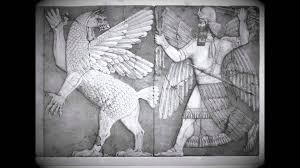
Themed Bible Study: Chaoskampf.


In the above Babylonian relief we see Tiamat, the personification of chaos, being defeated by the god Marduk. Here an act of  creation is represented as a struggle against chaos or chaoskampf. According to Wiki:

In the second [part of the] Chaoskampf  [myth] Tiamat is considered the monstrous embodiment of primordial chaos. Some sources identify her with images of a sea serpent or dragon.

This Babylonian creation myth has points of contact with the Biblical themes of chaos, Satan and the serpent. In the Bible similar ideas of Divine creation vs the forces of anti-creation can be found. Human sin and Satan put the self first disrupting cooperation and harmony thereby contributing to the abyssal deep of chaos, the domain of the Leviathan. 

My recent Bible study on these themes can be found here:

Tuesday, June 19, 2018

Bible Study and The Mechanism of Mind.

The mechanism of mind: So complex that it's beyond self-understanding? See here


It's undoubtedly true to say that one best learns about the highways and byways of the Bible through thorough personal study and even more so if one is preparing to lead a Bible study group; the latter rightly requires the gathering of lot of back up and contextual information for potential reference. This information, although much of which will not be used in the study group, nevertheless helps resource one's mind, either to be boiled down to something significant or later used as a vital cognitive link at some stage. The mind, needless to say, is a complex mechanism, perhaps well beyond its own self understanding and its creative abilities probably result of its non-linearity which introduces all but unrepeatable sequences of thought. There is only one power that is sovereign over such complexity, and that is God himself. 

Recently I lead a house group studying the second half of John 1. My study notes can be picked up using the link below. In some ways this study adds to the backlog of my never-to-be-finished dream projects:This is what the start of a complete study of John's Gospel would look like if I ever had the time and privilege to do the full series on John's Gospel. But given a mix of intellectual pressures, absence of opportunity and today's existential-crisis oriented spiritual values which majors in the esoteric "encounter" as the linchpin of faith, I think that's a project which is not to be!


John 1 Study Link

Tuesday, October 03, 2017

Lessons from the Minor Prophets


I've being leading a Bible study series on the Minor Prophets and below I've published links to the study notes I have compiled. 

Core Christianity, when I eventually understood it, was a revelation; it was as if a mist had gone from my eyes. I experienced that turn-about face which many converts know; namely, that salvation isn't about us taking the initiative and winning our stripes but rather the initiative is on God's part: Here's Romans 8:15-17

15: The Spirit you received does not make you slaves, so that you live in fear again; rather, the Spirit you received brought about your adoption to sonship. And by him we cry, “Abba Father.” 16 The Spirit himself testifies with our spirit that we are God’s children. 17 Now if we are children, then we are heirs—heirs of God and co-heirs with Christ, if indeed we share in his sufferings in order that we may also share in his glory.

The metaphor of adoption is a good one, particularly given the Roman culture pervading the Middle East at that time: Favoured slaves, on the behest of their masters, were sometimes adopted into their master's family thereby receiving all the rights of sons and daughters. Hence much of the connotational content  in the above passage is lost on us today.

Christianity is less something you do than it is something that is done to you on the initiative of God. For countless years the religious paradigm has been that the faithful must engage in the superstitious fetishes found in practice, belief and ritual in order to appease deity and make right the contract between God and (wo)man. But it's the other way round; it is primarily all about what God has done and not what (wo)man has done; all we need do is agree to partake of the new contract.  Wanting to become a Christian and wishing to lead a (re)new(ed) life under adoption is all that is needed to become a Christian. There then remains the question of our acceptance/adoption by God - but we know what the answer is to that. After that the details, the experiences, the formulaic doctrinal expressions and interpretations vary and are often arguable.

For many years humans have tried to fix the human-divine interface by means of tedious rule driven minutiae of practice, practice that amounts to a form of ritualistic magico-manipulation. But the interface remains broken until the psycho-spiritual engine which drives it is fixed and only God can do that. 

But let me add a circumspect rider at this point. I have met numerous Christians with a sectarian bent who will insist on imposing their proprietary facade of belief and practice on others. And if that facade doesn't graft those others are thought of as at best inferior Christians and at worst heretical blasphemers. I have to confess that there is more than one argument for the untruth of Christianity and these sectarian reactionaries are certainly one of them!

However, as one reads the minor prophets one realizes that the foregoing considerations are very old themes. These prophets understood that inner spirituality could not be fixed simply via better religious and magico-ritualistic window dressing and one of their main laments was that Judah and Israel did not understand this. Get the engine fixed and the interface will look after itself.
.
Introduction

Amos

Jonah

Hosea

Micah

Nahum