Showing posts with label Norwich Churches and Belief Communities. Show all posts

Sunday, September 22, 2024

Politics at Norwich Cathedral


The Revd Andrew Bryant, Canon for Mission and Pastoral Care at Norwich Cathedral, wrote a Network Norwich and Norfolk pre-election article on the citizen's voting responsibilities. The article can be read here:

Network Norfolk : Why voting should be regarded as a spiritual act (networknorwich.co.uk)

In these days when the cut and thrust and contentions of constitutional politics are under threat from those who seek to disabuse us of the right to agree to disagree and vote on it, I found myself agreeing with the article. Here was my reply

Timothy V Reeves (Guest)           21/06/2024 11:00

Thanks for the article, Andy. I very much agree with your conciliatory tone.

The constitution, forums and media of democracy must be preserved; they cater for the truism that as frail & fallible human beings we have a natural propensity to disagree and contend and therefore contention must be managed by systems of arbitration & accountability. Obviously, there’s always room for reform and enhanced justice but let’s respect our democratic culture of accountability as the way forward: As you say:

<<"Just as God calls us frail, fallible disciples to be bearers of the divine light in the world, so too the governance of our nation is placed in the hands of equally frail and fallible men and women, who need are our affirmation of their willingness to serve rather than a continuing reminder of where they have fallen short. Even as they are held accountable at the ballot box, we too will be held accountable on the Last Day.">>

Excellent! May we take that quote to heart! The alternative is dictatorship and the threat posed by dictators-in-waiting who make loud claims to being the saviour of society. There is of course only one saviour.


***

Quoted from Network Norwich and Norfolk....

The Revd Andrew Bryant is the Canon for Mission and Pastoral Care at Norwich Cathedral. He was previously Team Rector of Portishead, Bristol, in the Diocese of Bath and Wells, and has served in parishes in the Guildford and Lichfield Dioceses, as well as working for twelve years with Kaleidoscope Theatre, a charity promoting integration through theatre for young adults with Down’s Syndrome.

You can read Andrew's latest blog entry here and can follow him via his Twitter account @AndyBry3.


Friday, March 08, 2024

The Shifting Fortunes of the Pulpit


St Mary's Baptist Church 1811 build: The pulpit figures prominently

The above picture shows the interior of the Regency chapel of St Mary's Baptist Church in the 19th century, a building whose foundation stone was laid in 1811 by its minister Joseph Kinghorn.  What is notable about this interior is not just the overwhelming centrality of the pulpit, but that the pulpit is installed against a blank wall - well, almost blank: As if to relieve the starkness of this wall some memorial plaques have since been fixed to it. But the message is, I think, nevertheless clear: That is, it is intended one focuses on the pulpit ministry and not be distracted by extraneous details which may not be usefully edifying. 

In those days I don't think the congregation had any instrumental accompaniment to their singing as there appears to be no space in the pew packed interior for a band, although I suspect the pews running perpendicular to the congregational pews were for a choir. It was only in 1863 after some years of resistance and three years after open communion had been won in a court battle that a small organ was gingerly introduced. Ideas were on the move and the fact that the church had presumed to adorn their pulpit wall with memorials to their esteemed forbears suggests to me they were becoming aware of themselves not just as sinful ears to be harangued from the pulpit, but also as a respectable sub-culture with a proud lineage.

As if to confirm that a revolution was slowly unfolding, in 1886 the chapel underwent a lavish Victorian refurbishment (See picture below). The pulpit wall was knocked out and extended into an apse-like chancel and this was then filled with an organ and choir stalls.  In contrast to the coy introduction of the organ over twenty years earlier, the new organ was a sophisticated and grand piece of machinery. It served as a sensational centre-piece in the refurbished building, sending a signal about the wealth of the church and its social status. But the extravagant hedge of organ pipes and the richly carved surrounding polished woodwork were in danger of upstaging the pulpit. The pulpit however was still central, if rather lost in all the competing detail; unlike the Regency chapel where the pulpit stood out against the nothingness of a pallid wall.

St Mary's Baptist Church after the Victorian refurbishment of 1886 

In 1890 St Mary's Baptist Church planted a daughter church on Sayers Street in Norwich. In 1905 this new church went on to build the pseudo-Gothic pile of Dereham Road Baptist Church, serving the sprawling Victorian & Edwardian suburbs in that area. At the sharp end of Dereham Road Baptist Church we find a central organ/choir/communion table/pulpit configuration that has striking similarities with the configuration at St Mary's Baptist Church (See the picture below). Although the pulpits of both churches were now surrounded by competing details the overall impression, however, is that both churches still gloried in the pulpit and its ministry of words. 

St Mary's daughter church; Dereham Road Baptist.

Unfortunately, St Mary's elegant regency building with its rich Victorian interior was destroyed by a combination of fire in 1939 and a WWII bombing raid in 1942. But when St Mary’s congregation came to rebuild their post war church in the late 1940s and early 1950s something strange happened: The pulpit was shifted to the left of the communion table and stood in sentry at the mouth of a well-defined chancel; a configuration found in many C of E and Catholic churches. The pulpit was no longer vying for central attention as in days of old. Instead, we find only the communion table at the centre.... See the picture below:

St Mary's post war rebuild.

This change may have come about because history was now telling these non-conformists they were no longer a persecuted sect, in fact quite the opposite: They had been sympathetic to the North American revolutionaries and were vocal in their opposition to slavery; history had come out on their side. Moreover, they were now respectable pillars of society and had behind them a history of knights, MPs, and successful businessmen.  They would have therefore felt themselves to be on a par with the state church. In fact, the architecture of Dereham Road Baptist Church is evidence that they were already flirting with an establishment look as far back as 1905; that contrasted with the early days when non-conformists preferred a secular classical look as opposed to the state church gothic look; in those days classical architecture help set them apart from the state church. But there may be more to it than this: After two devastatingly destructive mega-death world wars the like of which were unprecedented in all human history there may have been a sneaky feeling that no rationale articulated in words alone could do justice to the human predicament.

In times of crisis & doubt there is a tendency for human beings to find consolation in mystery and the esoteric. During the first world war protestant soldiers would often resort to Catholicism's arcane rituals of death in order to derive some comfort in the face of mortality. In the first half of the 19th Century the Catholic architect Augustus Pugin tried to revive the flagging devotion of the industrialized masses with the architectural finery and romantic mysticism of the gothic revival.

But many protestants were also starting to behave as if words were not the only experience to be had in church. In the above picture of St Mary's Baptist Church, the centrality of the communion table may signify that there was a shift away from pulpit culture toward the mystery of communion with God. But this relatively mild change was a portent of more fundamental shifts that came in the second half of the 20th century when the ministry of words was to find itself jostling with the ministry of esoteric experience. This reached a crescendo in the 1960s onwards as sublime gnostic encounters with God were regarded as the acme of Christain experience..... in fact, when I once recommended a scholarly & intellectual Bible teacher of my acquaintance, I was told that his ministry was like going back to the dark ages! At that moment I knew I was now in a culturally alien landscape to which I could contribute little. In much contemporary Christian culture faith centers around the mystical "encounter" with God. "Encounter" is now a rather hackneyed buzz word, heard everywhere in today's passion centred Christian communities; it connotes a deep mystical tryst with the divine. Not that I think there is anything wrong with ecstasies and sublime encounters with God; the trouble comes when these experiences are used as a shibboleth of an underlying authoritarian "gnostic" philosophy (See here).

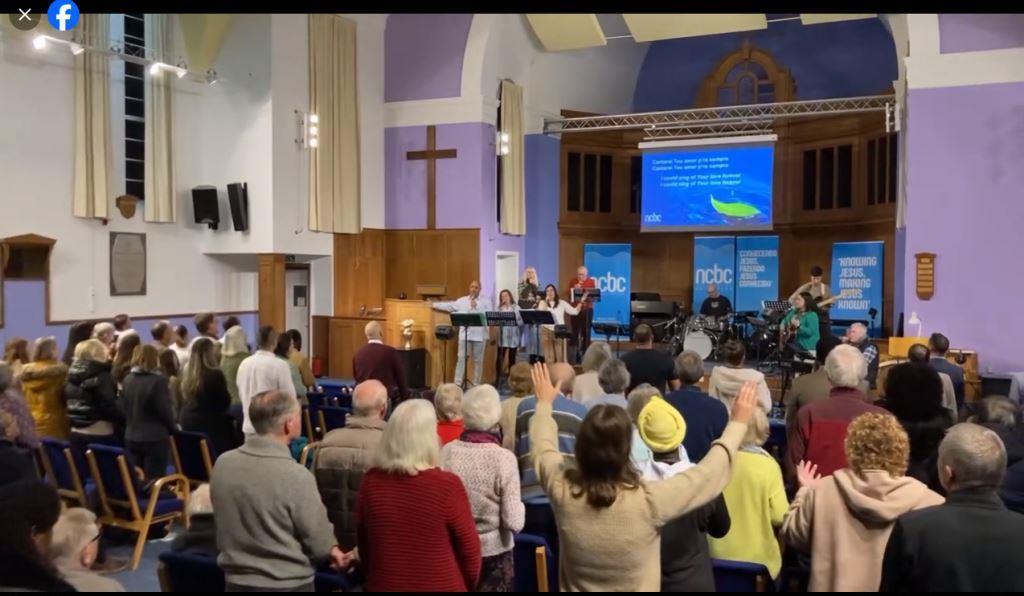
Today services at St. Mary's Baptist Church (Now called Norwich Central Baptist Church) look like this.....

Worship today in Norwich Central Baptist Church.

The offset pulpit is now redundant and only used as a hideaway for sound equipment and other items; it no longer serves as a way to give non-conformist sermons some kind of cathedra authority; that may not be a bad thing. However, in its place one is likely to see the animated personable talking head who has plenty of personality; no longer confined to the few square feet of the pulpit they also have plenty of maneuvering room on a large stage. This stage may also be occupied by a band which is there to help the congregants lose themselves in the reverie of the worship experience, when they are not picking their way through the pith of the ministry of words. As it is at NCBC so it is with many other modern worship venues. At NCBC, however, there remains a healthy balance between Logos and Pneuma.  

My theory is that these changes in Christian culture are driven by changes in the wider society where the church no longer has an authoritative voice in that society. The story told by the church as a sense making "cosmic mythology" no longer resonates in the wider world.  I can understand that as a cultural (over) reaction to contemporary conditions (Although I, of course, beg to differ with that reaction). In this context to appear to practice some kind of pulpit-based cathedra authority may come over as presumption, even among church goers. When words cut less ice and their impact is exhausted there is a yearning for sublime encounters with the transcendent God.  This yearning has upsides and downsides; by itself it is not entirely healthy as words are needed to regulate the potential excesses of gnosis. 

***

But in spite of these profound cultural changes, we don't have to go very far to find something that harks right back to the first half of the 19th century. Across the road from Norwich Central Baptist Church is a small Strict and Particular Baptist church which calls itself "Zoar Chapel". Inside the walls of its plain unfussy exterior, we find this:

Inside Zoar Chapel just across the road from NCBC

In this small Christian dynastic cultural pocket, it is as if nothing has changed for the last two hundred years. It has a pulpit standing against a featureless wall, thus allowing nothing to upstage the ministry of words. The only concession seems to be the small organ on the right-hand side below the pulpit. Such groups jealousy guard their doctrines. Even though the congregants at the massive pile of NCBC across the road bill themselves as faithful evangelicals (a title which must nowadays be distinguished from today's North American far-right Trumpian evangelicalism) they are likely to be regarded by Zoar Chapel to be in the grip of compromise. To the members of Zoar Chapel the stasis of their practice and belief is evidence they are attuned to timeless and universal truths. They therefore pride themselves as being unaffected by the changes in modern culture which shapes the practices of Christians beyond their walls - if indeed they even think of them as Christians! 

Monday, May 20, 2019

Views of Norwich From a Roof Top


A year or two ago I took some photographs of Norwich from the roof of Norwich Central Baptist Church. These photos can be seen in  this PDF.  Below I have reproduced the introduction:

***


The pictures in this album show Norwich City landscape from the vantage point of the roof of Norwich Central Baptist Church. Over the years new build has made this area increasingly residential reversing the 20th century English trend to escape the inner city. But as per most churches today, NCBC has a widely spread congregation with a catchment radius that perhaps extends up to ten miles and overlaps with the catchment areas of other church congregations. Modern changes, not least waning church attendance and modern transport, have meant that today’s churches seldom serve their local “community”.  This has lead contemporary church attenders to select a church less on the basis of vicinity than on the basis of the church culture and where they feel they can settle down and connect.

The pictures were taken about two years ago and actually capture a view that is no longer available as a consequence of the construction of flats adjacent to NCBC (The empty demolition site just prior to building can be seen in the photos).  These photographs, therefore, were taken just in time to provide evidence of a remarkable historical transition that has taken place over the centuries. They show how difficult it is to snap a general view of Norwich without including several old mediaeval churches in the frame. The density of these gothic edifices is evidence that in those days churches really were “local community” churches in the sense that they served a public that was within a stone’s throw.

I remember doing this guided tour for a group which included Americans and Australians. As they did the tour they were astonished that one only had to walk a few yards before yet another medieval church came into view. Modern conditions, however, have changed what “community” means and this presents challenges to people who are still inclined to think of community in purely geographical and parochial terms.

Thursday, April 04, 2019

Roman-Saxon-Norman Norwich and St Julian.

Click to enlarge this view of Norwich as seen from the east. (North is right and south is left)

I recently spent an inspiring Saturday morning on a history walk in Norwich's King street area. The guide was Alan Gidney of Norwich Central Baptist Church. We also had with us a guide who was going to tell us about the world famous St Julian of Norwich, an anchorite whose cell is attached  to St Julian's church, a church within a stone's throw of  King street's Dragon hall; the latter being our assembly point.

Alan linked King street with the Roman road running from the northgate of Caistor Roman town  (Venta Icenorum), a fortified settlement about four miles to the south of Norwich. On the 3D Norwich map at the top of this post (Courtesy of Google) Caistor is off to the left. It is not known, said Alan, whether King street is on the line of the actual Roman road or whether it followed the line of Ber street, a street which runs roughly parallel to King street and is a little further up the Wensum valley side. Ber street and King street are both marked on my map. But in any case neither road has a good alignment with the road running from the north gate of Caistor Roman town, so presumably the road from Caistor had a kink in it at some point. Hazarding a guess: The Roman road from Caistor may have run along the east side of the River Yare until it arrived at a cross-roads near Trowse, whereupon a north west connection from the cross roads ran either to Ber Street or King street.

King Street, looking south. The front of Dragon hall can be seen in the centre distance.


The uncertainty about whether Ber street or King street is the original Roman road is expressed  in the following passage taken from this web site.

Although there is no substantial evidence of a Roman town within Norwich city walls, Venta Icenorum - Caistor St Edmund, just south of Norwich - was the focus for Roman settlement, selected for its fertile soil and good communications.

The area of modern Norwich was crossed by two major Roman roads suggesting that it was important, but not as a settlement. Evidence suggests that Holmstrete Way ran east west (modern Bishopsgate/St Benedicts) and a further Roman road ran north south along King Street or and Ber Street and then up Oak Street.

So, Oak street is also thought to be on the line of the Roman road. On my map I have marked Oak Street and also Charing Cross. Charing Cross may have been the place where the road from Venta Icenorum crossed Holmstrete.  If my map is anything to go by then Ber street has, apparently, a much better alignment with Oak Street and Charring cross than does King street. (However, Roman roads sometimes incorporated kinks in order to avoid difficult terrain, so this is no proof that Ber street is our Roman). King Street, on the other hand, has a reasonable alignment with Fye bridge (marked) to the north. In Saxon times Fye bridge was actually a ford and it therefore seems not an unreasonable conjecture that King street was, in fact, a Saxon deviation from the Roman road which made for the ford; presumably the well engineered Roman bridge that crossed the Wensum had long since decayed and fording the river was the cheapest Saxon alternative.

King street gets its name from the Saxon village of "Conesford" or "King's ford". Conesford was a village lying immediately to the south of the ford and was clustered around the point where King street was crossed by Holmestrete  On the other side of the ford lay the fortified Saxon town of Norwik (From which we get "Norwich"). Magdalen Street (marked) ran down the centre of this town, a town with a ditch and bank rampart and probably topped by a wooden palisade; it was in effect the "New Caistor".  As a fortified town Norwik had burgh status and was therefore permitted by the Saxon king to mint coins.

After the Norman conquest the centre of gravity of Norwich moved south, up and out of the Wensum valley toward the Ber Street ridge on which the Norman castle was built overlooking and dominating the Saxon villages in the Wensum valley. It may be at this point in history that King Street became the bustling inland "Port of Norwich", second only to the inland "Port of London". Although Norwich completely lost its second city status after the industrial revolution, I have early memories of it as a port for (small) sea going cargo ships, although today it is just a quay for Broad's pleasure boats.

St Julian's church is a short walk along St Julian's alley, an alley which intersects with King Street just outside the famous Dragon Hall. Dragon Hall was constructed in 1427 by the wealthy merchant Robert Toppes who made his money buying and selling with continental Europe. The feudal system introduced by the Normans had run about 300 years when St Julian was born in 1342 (She died sometime after 1416). But in the latter half of the fourteenth century the feudal order was under the hammer as history was in the process of making a transition. In consequence St Julian's life covers some significant times and dates. Viz:

* The Black death 1349 (England)
* The Peasant's revolt 1381
* The mid 14th century rise of John Wycliffe's Lollard's many of who were burnt at Lollard's pit a short way upstream at from Dragon hall. They were in effect pre-reformation reformers and were considered a danger by Roman Catholic authorities.
* The Canterbury tales 1387 - 1400
* The rise of the middle classes: e.g. Robert Toppes 1400-1467 who built Dragon hall in 1427

It is a reasonable conjecture that all the dates I have listed after 1349 have their roots in the effects of the Black Death, the plague which resulted in a 40% reduction in the population and consequently left many feudal agricultural strips unfarmed. Peasant tenants moved into the fallow land and started to make a profit and eventually bought cheap land to farm; they became the land owners often referred to as yeoman farmers, eventually to become contiguous with the gentry. They were the beginnings of the up and coming middle classes who in due course became rich and influential. English social mobility had arrived. An example are the Paston family who even moved into Caister Castle on the coast north of Gt.Yarmouth (not to be confused with Caistor Roman Town). Ever since those times the rich middle classes have had a tendency to ape the English aristocracy if they could.

The power of the feudal aristocracy whose wealth lay in their unquestioned ownership of farm land (the source of medieval wealth) was weakened by the Black death. The Black death lead to a lack of peasants to till the land and this in turn made land a buyer's market. But the feudal aristocracy continued to rule as if nothing had happened. The peasantry and early middle classes weren't wearing it and revolted. But this revolt was premature; the aristocracy were still very powerful and it took at least another three centuries before, in stages, the middle classes successfully took their place in the corridors of power. In the meantime the middle classes put their heads down and got on with the business of making money, Robert Toppes being an example.

Another connected factor in the peasants revolt may have been a subtle change in social ethos after the Black death. Evidence of this might be apparent in the Canterbury tales where it is clear that Chaucer was pondering carefully the meaning of social class. After all, the Black death was no respecter of persons; it was proof that all humanity was equal under God, although it should have been noticed that this equality was implicit in scripture from day one. Just before his execution in 1649 Charles I declared his belief in the royal blood line's divine right to rule. Charles I's execution is therefore symbolic of the death of the concept of an  aristocracy with a God given right to sovereignty.

The entrance to Julian's cell.: A Norman arch. It therefore pre-dates St Julian by at least 200 years. Her original cell probably did not include this entrance. She may have been bricked in with openings left for communication, food, hygiene and other basic needs. 

Into this mix comes the mystic St Julian. Today King street comes over as a sleepy residential area but our guide told us that in St Julian's day it would been a busy inland port area with people coming and going. Our guide also hinted that St Julian may have chosen this area because she felt that it was where she was most needed. After all, ports don't have a reputation for being particularly moral. Moreover, if the Canterbury tales are anything to go by we can imagine that street level culture here was pretty raw! (as it always has been I suppose!) So St Julian had her work cut out! Unlike the Lollards, however, St Julian didn't see herself as challenging the Roman Catholic church; a church that was in actual fact in much need of reform and challenge. But St Julian's theology was not entirely in keeping with that church. One of her doctrinal novelties was her stress on the motherly feminine aspect of God and Christ, a role reserved in Catholic thought for the Virgin Mary. But St Julian didn't go out of her way to rock the boat and in those days she was still a relatively small fish and could be safely be ignored. As for the Lollard's, at first the secular authorities tolerated and even protected them, but when they became linked to the peasant's revolt they lost this protection and many were burnt at the stake. Like the peasant's revolt the Lollard movement was premature; times were not yet ripe for a big change.

Standing in St Julian's cell for me was reminiscent of my visit to the Church of the Holy Sepulchre in Old Jerusalem. In both locations little or nothing remains of their original aspect making it difficult to make an imaginative connection with the past. Moreover, in my particular case picking up holy vibes is simply not one of my strengths. This fairly plain, clean, smooth, minimalist white washed cell was not going introduce me to a meditative mindfulness; not that much else has a chance of doing that either! A commemorative board just outside the cell says "In this holy place we can almost hear St Julian saying...so & so." Well, I didn't hear her! None of this is to say, however, that many people don't meet with God in the midst of contemplative silence.


And now to modern times: The St Julian controversy

St Julian's teaching. Traditional reformists will hate it.  Needless to say after a quick search on the Web I found....!


In reformation England St Julian's writings were rescued and hidden; she was after all a Roman Catholic Saint. But her writings eventually resurfaced and became popular in the West, perhaps on the back of a resurgent Romanticism. However, traditional "logos" based protestant believers who strongly identify with the reformation will find her writings at best wanting and at worst heretical. For example the following typifies a heavily reformist reaction to St Julian:


.....nowhere in Scripture are we taught “the Trinity is our Mother,” or that Jesus—the unique Son of God—is our “true Mother,” and we’re certainly not taught, “All shall be well.” The late Dr. Walter Martin, a very well-respected evangelical apologist, was correct when he said: The vast majority of mankind; will not make it [to salvation], because they simply will not repent. And if you don’t think these people are lost; then why in the world are you even bothering to call yourself a Christian. Study mysticism, as I have, and you’ll see a common thread of universalism within it.

In closing this subject, for now, Julian of Norwich falls right in lock-step with classic mysticism of all stripes with its panentheism (all in God), pelagianism (true self, which is sinless), “a spark of the divine” where, in contradistinction to Scripture, God already dwells within all of mankind and concluding with Julian’s belief in a universal salvation.
(See http://apprising.org/2010/05/09/setting-the-record-straight-on-julian-of-norwich/)

With their tendency toward an unimaginative and stark factualism fundamentalists are often found arguing over metaphors that they interpret literally. It is certainly true that some metaphors are better than others, but if you are a literalist what should be a discussion on merit and appropriateness becomes a black vs. white battle of truth vs. falsehood, a fight between good and evil, thus releasing huge passions, emotions and acrimony. As they diligently search the Bible for "theological algorithms" which provide exact rules giving unambiguous guidance about belief and practice, it is no surprise that a book which often uses language connotationally should cause fundamentalists to fall out with one another very acrimoniously over issues which should be treated as a question of nuances of meaning. An example of such a fall-out is the council of Chalceden (451), a council attempting to settle the contention between Nestorius and Cyril over the nature of the Trinity. It represents a timeless theological fracas caused by inflexible literalist thought. Prime suspect as to the root of the cognitive dissonance at Chalceden is the concept of "hypostasis" or "substance", terms which are clearly metaphors derived from the material world and applied literally and uncritically to the Godhead. It is no surprise that the black vs white fundamentalist mind will instinctively recoil from the sometimes woolly & sloppy language used by the Christian mystic.

One can repent, believe in the Lord Jesus and receive the gift of adoption from the Father and yet in my experience what chiefly characterises fundamentalist believers is that in practice they understand "repentance" in terms of affiliating oneself to their culture's specific rendition of Christianity; all other contrary Christian cultures are likely regarded as simply unrepentant. Close approximations to the Gospel can be found among Jehovah's Witnesses and yet one knows that they too are likely to consider anyone who does not connect with their holy remnant as unrepentant and therefore non-christian, no matter how emphatic one is about receiving the Gospel. For one quickly finds that in the eyes of fundamentalist Christians of all types (and this includes JWs), salvation is practically conditional upon the acceptance of their subculture as exclusive. Keeping fundamentalists at arm's length (A policy I actually advocate) is, to the fundamentalist mind, tantamount to a ticket to hell; see here, here and here. Expressions of the acceptance of the Gospel outside their culture are all but worthless to them. But having said that I can no more defend fundamentalist reformers than I can Christian mystics who err on the side of gnosticism and like their strict reformist siblings also regard those beyond their "enlightened" culture as of an inferior spirituality. 

The reformation brought an end to the Roman Catholic monopoly on Latin Christianity. Subsequently, in the West God no longer had all his apples in one basket where they could all go bad together. But human nature remained the same and those Protestants too enamoured of the divine authority of their opinions, following medieval  Roman Catholicism, believed there remained only one basket - their's!*


Addendum 15/04/2019
https://www.networknorwich.co.uk/Articles/546301/Network_Norwich_and_Norfolk/Resources/Events/_Julian_of_Norwich_celebrated_with_weekend.aspx

Footnote:
*As has become so apparent in my Creation researches evangelical Protestants are very tempted by a dualist world view, a view where God's creative power is instinctively distinguished over and against the profane "hypostasis" of matter; shades of gnosticism haunt many dark corners of Christian culture. And yet it is the sovereign transcendent God who has created the cosmic miracle of space & time and whose omnipresent  immanence sustains it and continues to create.

Saturday, September 15, 2018

Another church for my “beetle collection”.


Catalogue without boundaries: Some of the species of The Open Gospel

Recently I was asked by a friend if I would like to visit the Sunday service of a church in Norwich. He felt that this church needed some investigation. So, one Sunday he and another friend found ourselves at the morning service of “Servant’s Church”. The report of this visit (which I sent to both friends) can be found here.
Servant’s Church is part of the Calvary Chapel network of churches. This network has its origins in the Jesus Movement of the 1960s and the vision of charismatic leader Chuck Smith. It follows a pattern found among some other fellowships in Norwich: Viz; a single founding patriarch and a mentoring organisation with its centre of gravity in America. A similar pattern can be seen in the Potters House church, The Living Stream Ministry fellowships, Bethel Church, Vineyard, the Jehovah’s Witnesses and the Mormons. All these brand-named versions of Christianity have at least one affiliated fellowship in Norwich. To these churches we can add a miscellany of sectarian fellowships with origins closer to home such as the Plymouth Brethren, Closed Brethren, Strict & Particular Baptists, the Jesus Army, Reformed churches and reformo-charismatic. All these groups tend to view themselves as distinct from and superior to the more traditional protestant groupings (e.g. the Church of England, Methodists, Baptist Union, Salvation Army, United Reformed, Assemblies of God, Elim, the FIEC, and the Open brethren) and also superior to the newer mainstream charismatic churches (e.g. New Frontiers, Hillsong and Alive church). However, traces of sectarianism and fundamentalism, to a greater or lesser extent, can even be found among mainstream churches.

I don’t think Norwich is unusual in having such a bewildering array of protestant factions on top of its more mainstream groupings. Moreover, their number has been increased by the relatively recent appearance of several black (immigrant) churches. I have never attempted to formally catalogue all these fellowships/churches/groups/affiliations/congregations/assemblies. I have only succeeded in listing some of them simply because they have, for one reason or another, come to my attention; I haven't gone out looking for them, they have simply drifted into my line of sight. For example, I didn’t know about Servant’s church until my friend brought them to my attention. I have a feeling that I don’t know the half of it: Consider, for example, what I referred to as the “Car park” sect; they popped up out of the blue when they placed tracts on all the cars in the Norwich Central Baptist Church car park. Up until that moment they were completely unknown to me*1. Cataloguing churches is like cataloguing beetles: Creating an exhaustive catalogue of these congregations along with pithy descriptions summing up what they are about would require more time than I am able to give. Many of them, needless to say, consider themselves as the one and only exclusive model to follow if you want to know how to do church properly!

During the service at Servants I spotted someone I had become acquainted to in another connection and this gave me the opportunity to catch up with him and find out what he thought of his chosen fellowship. To disguise his identity in my report I have called him “Charlie Neblus”.

Footnote
*1 I must be cautious though. New sects tend to disguise their sectarian agenda and shun any badging brand names, names which readily identify who they are and their origins (see my report for suggested reasons why). Therefore sometimes it is possible to think one has stumbled on a new sect when in fact it is a sect one is already familiar with.

Friday, December 25, 2015

Christmas Midnight Eucharist at Norwich Cathedral

Norwich Cathedral: Romanesque and Gothic
The liturgy at Norwich Cathedral for the Xmas midnight service is, in my opinion, inspiring. It picks out all the positive aspects of the faith which we associate with Xmas and explains why Christmas brings light, hope and faith to millions of souls who have otherwise lost their way or are oppressed by darkness. Below I reproduce a few of the highlights from the order of service:

Prayers of penitence before the crib
Deacon: Christ the light of the world has come to dispel the darkness of our hearts. Let us turn to the light and confess our sins.
All: Amen
Deacon: God our father you sent your Son full of grace and truth; forgive our failure to receive him.
All: Amen
Deacon: Jesus our saviour you were born in poverty and laid in a manger; forgive our greed and rejection of your ways.
All: Amen

The Collect:
Bishop: Eternal God who made this most holy night to shine with the brightness or your true light..bring us, who have known the revelation of that light on Earth, to see the radiance of your heavenly glory; through Jesus Christ your Son our Lord, who is alive and reigns with you, in the unity of the Holy Spirit, one God, now and forever.
All: Amen.

A Christmas proclamation
Choir: God is with us. Hear ye people. Even to the uttermost end of the earth. The people that walked in darkness have seen a great light. The people that dwell in the shadow of death, upon them the light has shined. For unto us a child is born! For unto us a son is given! And the government shall be upon his shoulder; And his name shall be called Wonderful! Counsellor! The Mighty God, the everlasting Father, the Prince of peace. Hear ye people. Even to the uttermost end of the earth. God is with us. Christ is born!

Hymn: It came upon a midnight clear
All: For lo! the days are hastening on,
By prophet bards foretold,
When, with the ever-circling years,
Shall come the Age of Gold;
When peace shall over all the earth
Its ancient splendors fling,
And all the world give back the song

Which now the angels sing.


Prayers of intercession
Bishop: Father, in this holy night angels and shepherds worshiped at the manger throne. Receive the worship we offer in fellowship with Mary, Joseph and all the saints through him who is your Word made flesh, our saviour Jesus Christ. 
All: Amen.

The distribution
Bishop: Jesus is the Lamb of God who takes away the sin of the world. Blessed are those who are called to his supper.
All: Lord, I am not worthy to receive you, but only say the word, and I shall be healed.


My Comment
A humble stable, a helpless new born, a manger throne, worshiping ouctast shepherds, gentile astrologers, a mother of humble birth,... and above all the lamb of God who was to give himself to the uttermost.....who would have thought that these were to be the means by which in these last days God has spoken. Whoever, except from a divine perspective, would be able to say of those who viewed such an apparently prosiac scene: The people that walked in darkness have seen a great light!

The stable throne isn't the natural revelatory expectations of guilt and angst ridden human religion, religion which likely majors in one or more of: high and mighty patriarchal rulers, power, authoritarianism, sectarianism. judgement, condemnation, rule driven salvation, punishment by torture, vengeance, fear, hell and hamnation for the infidel, gnosticism for the spiritual elite etc....... this clustered complex fills the heads of those who have yet to see a vision of the God of grace for themselves or who think the gospel is only for their very bespoke religious community with its proprietary practices and beliefs.  

In the above liturgy, however, we see divine self-revelation. In all its facets the Gospel is beyond human creative spiritual thought; the evidence of that is seen in the fact that just about every doctrinaire religious sectarian I have met, I have found they do all they can to de-legitimize and undermine the means by which the liturgy above is commended to one's heart, namely, the Spirit of Adoption which cries out "Abba, Father!"

In humble circumstances we find The Unexpected Revelation

Sunday, March 22, 2015

NCBC History Walk Version 5


Norwich started as a cluster of Saxon thatched huts in a river valley; after nearly a 1000 years the cathedral still dominates that valley.

A new version of my Norwich Churches and Belief Communities history walk can be downloaded from here.

Monday, November 20, 2006

MIRROR, MIRROR.....
Norwich Central Baptist Church is part of a phenomenon I have called the “Wensum Valley Churches”. These are a group of protestant churches that huddle around an ancient meander in the Norwich Wensum valley and I list them as follows:

Norwich Central Baptist Church (conservative), Surrey Chapel (orthodox), Silver Road Baptist (Traditional?) Zoar Chapel (Strict and Particular), JW Kingdom Hall (Cult), Wensum Chapel, now City church (Charismatic), The Octagon chapel (Traditional), Princes Street UR (Traditional). The Cathedral (Traditional). St. Augustine’s (Emerging/postevangelical church), St Luke’s (Postevangelical/emerging church),

Stretching the line a little one might also include “Potters House” (Charismatic Cult) on Dereham road, St Barnabus (traditional) and even Kings Church (Charismatic). Tell me if you think I should add anymore to the list. This is a phenomenon I am still studying, classifying and describing, and so I’ll appreciate any input. Some of my labels may be non-distinctions e.g. it is questionable if there is much difference between the ‘conservative’ NCBC and the ‘orthodox’ Surrey Chapel. However, I want these two labels hanging around just in case I should at some date need to fine-tune my categories. Some of the categories actually overlap. Take a good look at this group of churches – they are perhaps just as diverse as the seven churches of Asia minor (Revelation 2ff); this group of churches sprawl over the best part of the Protestant spectrum.

I have attempted to classify these churches by introducing a classification scheme that is not based on doctrine but has more to do with “style” than “content” (although style and content are often well and truly conflated) One can, in fact, find similar differences of ‘style’ in Judaism: - e.g. Judaism has the equivalent of ‘orthodox’, ‘charismatic’ and ‘cult’ styles. The generality of this taxonomy does suggest that factors, not uniquely Christian, are at work here to produce these variants. Something else must unite distinctly Christian churches, something far more fundamental than just how orthodox, gnostic, traditional or progressive churches are. For me it is easy to identify what it is: Truly Christian churches understand that their faith and anointing (of 1 John 1:23&27) are void unless underwritten by the ultimate sacrifice made by God Himself, in Christ. But having said that one has to admit that some of the above churches have adopted novel doctrines and idiosyncrasies that threaten the very core of this inclusive faith. However, for those churches who do grasp the Truth, the Truth that gives purpose to life, the universe and everything, they are united by one faith, one baptism and one spirit, in spite of themselves, whether they like it or not. You don’t choose your blood relatives – and by ‘blood’ I mean “Christ’s blood”.


Churches of Norwich look at your selves in the mirror! Don’t be tempted to admire your self or drift off into a narcissistic reverie of self-praise, discounting “all them other churches” as your spiritual inferiors or even apostate! Look in the mirror and see what you really are: You cannot dissociate yourselves from one another: from the outside you all look to be part of the same untidy theme of history, a rough and ready hodge-podge of sometimes ‘anointing denying’ people, a people whose religious elaborations piggy-back on a core faith. There are those churches amongst us who still hanker after a propriety branding of all other churches after their own image, and whose fragile sectarian conception of faith identifies the ecclesial remnant with just another tiny purist splinter group of no cosmic significance whatever, here today and gone tomorrow. Instead Christianity, in actual fact, has cut a broad fuzzy variegated swathe through history, a swathe that sometimes includes some very uneasy partners! We must strive for a robust historical conception of church that mirrors the real state of affairs we find both in Norwich and else where. This is the Open Gospel.

But the Open Gospel is not just a new fangled idea of information and systems theory: In their heart of hearts all true Christians know it:

Though with a scornful wonder
Men see her sore oppressed,
By schisms rent asunder,
By heresies distressed:
Yet saints their watch are keeping,
Their cry goes up, “How long?”
And soon the night of weeping
Shall be the morn of song!

One foundation yes, but a complex sometimes-tacky superstructure! (1 Cor 3:1-15!)