Saturday, May 30, 2026

The Bible Society's Bible Course 2.0


This post is a depository for links to the resources I created and used as a supplement to the material provided by the Bible Society's Bible Course (new version)

NB Caveat: I've used AI apps to help create some of the documents labelled "notes" below. AI can be used as a natural language interface for the interrogation of the many texts created by our civilization.  AI algorithms are based on the human neural model and have been trained using human generated texts.  Because of the clear human component involved in the creation & maintenance of AI, AI responses must be treated as opinions. Therefore just as one treats the opinions of any human being with caution so must we treat AI output. 

See: Quantum Non-Linearity: The AI Garbage Bubble?


Session 1: Bible Overview

Warm up Presentation: Presentation1.pdf - Google Drive

Supplementary Questions: God is the Question.pdf - Google Drive

On Biblical Authority: Biblical Authority.pdf - Google Drive


Session 2: Early Genesis

Warm up  Presentation: Early Genesis.pdf - Google Drive

Supplementary Questions: God is The Question 2.pdf - Google Drive


Sessions 3: Exodus

Warm up  Presentation: Presentation3.pdf - Google Drive

Supplementary Questions: God is the Question 3.pdf - Google Drive

AI Google notes: Notes.pdf - Google Drive


Session 4: Judges, Kings & Chaos

Judges, Kings & Chaos:  Judges, Kings & Chaos B.pdf - Google Drive

Supplementary Questions: God is the Question 4.pdf - Google Drive

Notes: Notes.pdf - Google Drive


Sessions 5: The Story of Loss

The Story of Humanity: Story of Humanity.pdf - Google Drive

Supplementary Questions: God is the question 5.pdf - Google Drive

Notes: Notes 5.pdf - Google Drive


Sessions 6 : The New Dawn

The New Dawn: The New Dawn.pdf - Google Drive

Supplementary Questions: God is the question 6.pdf - Google Drive

AI Notes: Notes 06.pdf - Google Drive


Session 7 : The New Community

The New Community: The New Community.pdf - Google Drive

Supplementary Questions: God is the Question 7.pdf - Google Drive

AI Notes: Notes7.pdf - Google Drive


Session 8: Revelation

Revelation: Revelation.pdf - Google Drive

Supplementary Questions: God is the Question 8.pdf - Google Drive

AI Notes: AI Notes.pdf - Google Drive


BIBLE COURSE 1.0

The notes I made for version 1.0 of the Bible course can be found by going to these posts

Norwich Churches and Belief Communities: The Bible Society's "Bible Course"

Norwich Churches and Belief Communities: Bible Course Session II: Genesis

Norwich Churches and Belief Communities: Bible Course Session III: Exodus.

Norwich Churches and Belief Communities: Bible Course Session IV: Judges & Kings

Norwich Churches and Belief Communities: Bible Course Session V: Exile & Prophets

Norwich Churches and Belief Communities: Bible Course Session VI: Jesus and the Gospels

Norwich Churches and Belief Communities: Bible Course Session VII: Acts and the Church

Norwich Churches and Belief Communities: Bible Course Session VIII: Revelation


Tuesday, November 18, 2025

God's Existence and Suffering and Evil


BIBLE STUDY SUBJECT:

In response to a commission to submit possible responses to the question of IS THEIR A GOD? and how does one respond to THE QUESTION OF EVIL & SUFFERING I submitted this short two page discussion paper....

 The Four Books.docx - Google Docs

***


For further discussion see these links....

On God's existence.....

Quantum Non-Linearity: Physics' irreducible logical barrier


On Suffering.....

Views, News and Pews: Chaoskampf and The Problem of Suffering and Evil

Norwich Churches and Belief Communities: Suffering & Evil

Sunday, August 03, 2025

A Monumental Gamble


The above is a photograph I took of an article in the Spring 2025 edition of a church magazine called Idea. The article is by Richard Gamble who is the driving force behind the building of the Eternal Wall of Answered Prayer pictured above. I first took cognizance of The Wall in this post:

Norwich Churches and Belief Communities: The Eternal Wall of Answered prayer

The Wall (yet to be built) is a truly monumental sized mobius strip filled with the accounts of answered prayer. In my original October  2020 post I reported the Guardian Newspaper telling us that the wall was.... 

An enormous Christian monument, more than twice the size of the Angel of the North, is to be built on the outskirts of Birmingham, fulfilling a vision its instigator says came from God.

The Eternal Wall of Answered Prayer will be constructed using a million bricks, each representing a prayer from a member of the public and its outcome. The aim is to “encourage and inspire people going through the storms of life”, said Richard Gamble, the project’s chief executive and a former chaplain of Leicester City football club.

The monument, which has been granted planning permission with work to begin next year, has three goals: to “preserve the Christian heritage of the nation”; encourage prayer; and “proclaim Jesus for the country”.

Well,  nearly five years later the wall hasn't even been started. In the article above Richard Gamble admits that the project is facing two problems a) Getting funding, although that, according to Gamble, is easier than b) finding those 1 million answered prayers of which Gamble says that so far he only has 40,000. He goes on to say why he thinks support for the project is patchy. But in spite of that the article ends by telling us that construction of the wall is to begin this year.

Monday, April 21, 2025

The Four to Six Mix


The 4 to 6 mix seems to be pretty steady although my sample taken
on this Easter Sunday returned a 3 to 7 mix. 


It is several years since I wrote on the subject of the "4 to 6 mix"; that is the ratio of males to females in the church I attend.  In my last post on the subject I recorded it as being steady at 4:6 and in an earlier post I was amazed that my very rough & informal sampling had returned the same ratio that had cropped up in a far more formal and rigorous church wide study. (See also the Australian stats above)

I've been sampling the male to female ratio on and off for around 18 years now and yesterday's count has finally come up with a different ratio: I was sitting in the gallery and counted the people in the two main pew blocks on the ground floor: Of the 112 people in these two blocks 34 were male and 78 female; that's a roughly 3 to 7 mix! Perhaps the variation has something to do with an increase in attendance on Easter Sunday. 


Sunday, September 22, 2024

Politics at Norwich Cathedral


The Revd Andrew Bryant, Canon for Mission and Pastoral Care at Norwich Cathedral, wrote a Network Norwich and Norfolk pre-election article on the citizen's voting responsibilities. The article can be read here:

Network Norfolk : Why voting should be regarded as a spiritual act (networknorwich.co.uk)

In these days when the cut and thrust and contentions of constitutional politics are under threat from those who seek to disabuse us of the right to agree to disagree and vote on it, I found myself agreeing with the article. Here was my reply

Timothy V Reeves (Guest)           21/06/2024 11:00

Thanks for the article, Andy. I very much agree with your conciliatory tone.

The constitution, forums and media of democracy must be preserved; they cater for the truism that as frail & fallible human beings we have a natural propensity to disagree and contend and therefore contention must be managed by systems of arbitration & accountability. Obviously, there’s always room for reform and enhanced justice but let’s respect our democratic culture of accountability as the way forward: As you say:

<<"Just as God calls us frail, fallible disciples to be bearers of the divine light in the world, so too the governance of our nation is placed in the hands of equally frail and fallible men and women, who need are our affirmation of their willingness to serve rather than a continuing reminder of where they have fallen short. Even as they are held accountable at the ballot box, we too will be held accountable on the Last Day.">>

Excellent! May we take that quote to heart! The alternative is dictatorship and the threat posed by dictators-in-waiting who make loud claims to being the saviour of society. There is of course only one saviour.


***

Quoted from Network Norwich and Norfolk....

The Revd Andrew Bryant is the Canon for Mission and Pastoral Care at Norwich Cathedral. He was previously Team Rector of Portishead, Bristol, in the Diocese of Bath and Wells, and has served in parishes in the Guildford and Lichfield Dioceses, as well as working for twelve years with Kaleidoscope Theatre, a charity promoting integration through theatre for young adults with Down’s Syndrome.

You can read Andrew's latest blog entry here and can follow him via his Twitter account @AndyBry3.


Sunday, April 28, 2024

The Problem of Suffering and Evil


I try to evade writing about this subject because a) Over the centuries gallons of ink have been spilt on this subject without a definitive solution b) Any "solution" proposed is in danger of trivializing the profundity of the question and usually withers away to nothing in the fierce heat of real suffering and evil.

However, as I recently attended a church session on suffering and evil I thought I'd better make a quick showing on the church FB page of how far my thinking has got on the subject and I reproduce that quickie FB post below; it is based on some ideas I expressed in a blog post I once made here.  It's a bit tongue in cheek though. 

***

How can an omnipotent/sovereign loving & personal God tolerate suffering in the world He created? Shifting responsibility to human and satanic responsibility doesn’t work because that simply reflects back on the Creator’s responsibility in creating beings with such a propensity to screw up and fail so badly. Forget it.

Here’s a quick back-of-the-envelope solution to the biggest problem of all time.

OK, so if we demand our Creator deals with suffering, where does He start? Which suffering does he knock out of cosmic history? Well, because the cosmos, like Jesus' garment, is a seamless whole with many interlinked dependences it is very difficult to remove suffering in a piecemeal fashion; it has to be dealt with as a whole. The result is that the demand to remove suffering & evil entails removing all of it from day one, effectively shifting creation into another very different universe and a very different history to the one we know……Because our own existence is seamlessly bound up with the world we are part of this would mean that us sinners would have to go as well. For me that presents a very personal dilemma: Either suffering goes and me along with it, or the suffering world stays. The other thing I’d miss in a perfect world is that my favourite Bible verses, Phil 2:1-11, wouldn’t exist either. And I’m sure that if I found myself in a perfect world it wouldn’t be perfect for very long!

These considerations turn the problem of suffering and evil on its head: Viz: We have a big, big dilemma problem in the absence of suffering and evil. But perhaps because of Phil 2:1-11 the Sovereign Creator (bless His name) has selected our cosmic story for reification from among the many possible stories that can told. That reification must have cost Him a dearly in emotional pain. I suppose that's what we call grace.

QED(?).

Well, perhaps not QED, but the above can be the basis of more sophisticated thinking!

Friday, March 08, 2024

The Shifting Fortunes of the Pulpit


St Mary's Baptist Church 1811 build: The pulpit figures prominently

The above picture shows the interior of the Regency chapel of St Mary's Baptist Church in the 19th century, a building whose foundation stone was laid in 1811 by its minister Joseph Kinghorn.  What is notable about this interior is not just the overwhelming centrality of the pulpit, but that the pulpit is installed against a blank wall - well, almost blank: As if to relieve the starkness of this wall some memorial plaques have since been fixed to it. But the message is, I think, nevertheless clear: That is, it is intended one focuses on the pulpit ministry and not be distracted by extraneous details which may not be usefully edifying. 

In those days I don't think the congregation had any instrumental accompaniment to their singing as there appears to be no space in the pew packed interior for a band, although I suspect the pews running perpendicular to the congregational pews were for a choir. It was only in 1863 after some years of resistance and three years after open communion had been won in a court battle that a small organ was gingerly introduced. Ideas were on the move and the fact that the church had presumed to adorn their pulpit wall with memorials to their esteemed forbears suggests to me they were becoming aware of themselves not just as sinful ears to be harangued from the pulpit, but also as a respectable sub-culture with a proud lineage.

As if to confirm that a revolution was slowly unfolding, in 1886 the chapel underwent a lavish Victorian refurbishment (See picture below). The pulpit wall was knocked out and extended into an apse-like chancel and this was then filled with an organ and choir stalls.  In contrast to the coy introduction of the organ over twenty years earlier, the new organ was a sophisticated and grand piece of machinery. It served as a sensational centre-piece in the refurbished building, sending a signal about the wealth of the church and its social status. But the extravagant hedge of organ pipes and the richly carved surrounding polished woodwork were in danger of upstaging the pulpit. The pulpit however was still central, if rather lost in all the competing detail; unlike the Regency chapel where the pulpit stood out against the nothingness of a pallid wall.

St Mary's Baptist Church after the Victorian refurbishment of 1886 

In 1890 St Mary's Baptist Church planted a daughter church on Sayers Street in Norwich. In 1905 this new church went on to build the pseudo-Gothic pile of Dereham Road Baptist Church, serving the sprawling Victorian & Edwardian suburbs in that area. At the sharp end of Dereham Road Baptist Church we find a central organ/choir/communion table/pulpit configuration that has striking similarities with the configuration at St Mary's Baptist Church (See the picture below). Although the pulpits of both churches were now surrounded by competing details the overall impression, however, is that both churches still gloried in the pulpit and its ministry of words. 

St Mary's daughter church; Dereham Road Baptist.

Unfortunately, St Mary's elegant regency building with its rich Victorian interior was destroyed by a combination of fire in 1939 and a WWII bombing raid in 1942. But when St Mary’s congregation came to rebuild their post war church in the late 1940s and early 1950s something strange happened: The pulpit was shifted to the left of the communion table and stood in sentry at the mouth of a well-defined chancel; a configuration found in many C of E and Catholic churches. The pulpit was no longer vying for central attention as in days of old. Instead, we find only the communion table at the centre.... See the picture below:

St Mary's post war rebuild.

This change may have come about because history was now telling these non-conformists they were no longer a persecuted sect, in fact quite the opposite: They had been sympathetic to the North American revolutionaries and were vocal in their opposition to slavery; history had come out on their side. Moreover, they were now respectable pillars of society and had behind them a history of knights, MPs, and successful businessmen.  They would have therefore felt themselves to be on a par with the state church. In fact, the architecture of Dereham Road Baptist Church is evidence that they were already flirting with an establishment look as far back as 1905; that contrasted with the early days when non-conformists preferred a secular classical look as opposed to the state church gothic look; in those days classical architecture help set them apart from the state church. But there may be more to it than this: After two devastatingly destructive mega-death world wars the like of which were unprecedented in all human history there may have been a sneaky feeling that no rationale articulated in words alone could do justice to the human predicament.

In times of crisis & doubt there is a tendency for human beings to find consolation in mystery and the esoteric. During the first world war protestant soldiers would often resort to Catholicism's arcane rituals of death in order to derive some comfort in the face of mortality. In the first half of the 19th Century the Catholic architect Augustus Pugin tried to revive the flagging devotion of the industrialized masses with the architectural finery and romantic mysticism of the gothic revival.

But many protestants were also starting to behave as if words were not the only experience to be had in church. In the above picture of St Mary's Baptist Church, the centrality of the communion table may signify that there was a shift away from pulpit culture toward the mystery of communion with God. But this relatively mild change was a portent of more fundamental shifts that came in the second half of the 20th century when the ministry of words was to find itself jostling with the ministry of esoteric experience. This reached a crescendo in the 1960s onwards as sublime gnostic encounters with God were regarded as the acme of Christain experience..... in fact, when I once recommended a scholarly & intellectual Bible teacher of my acquaintance, I was told that his ministry was like going back to the dark ages! At that moment I knew I was now in a culturally alien landscape to which I could contribute little. In much contemporary Christian culture faith centers around the mystical "encounter" with God. "Encounter" is now a rather hackneyed buzz word, heard everywhere in today's passion centred Christian communities; it connotes a deep mystical tryst with the divine. Not that I think there is anything wrong with ecstasies and sublime encounters with God; the trouble comes when these experiences are used as a shibboleth of an underlying authoritarian "gnostic" philosophy (See here).

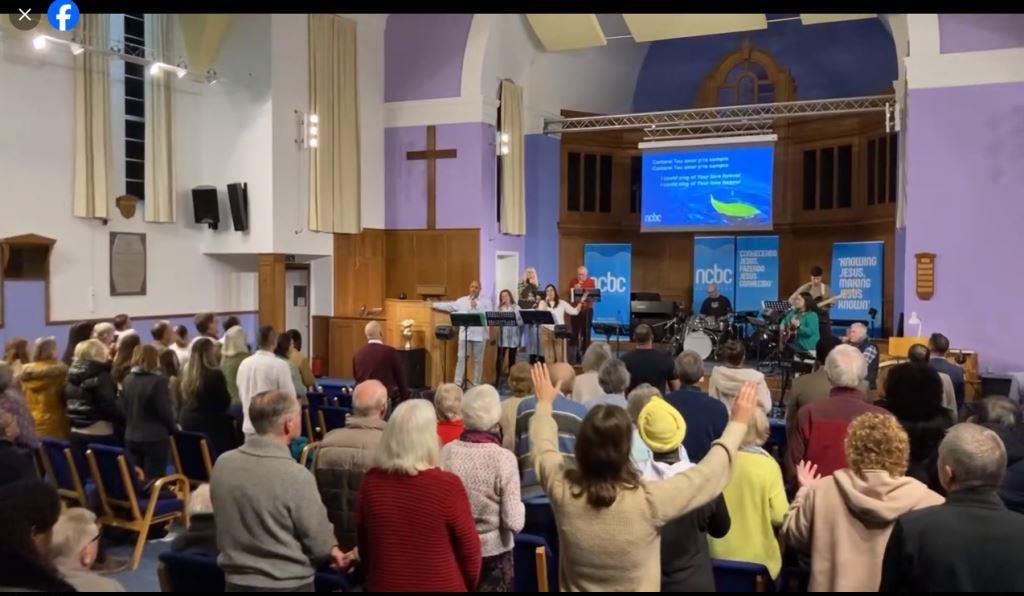
Today services at St. Mary's Baptist Church (Now called Norwich Central Baptist Church) look like this.....

Worship today in Norwich Central Baptist Church.

The offset pulpit is now redundant and only used as a hideaway for sound equipment and other items; it no longer serves as a way to give non-conformist sermons some kind of cathedra authority; that may not be a bad thing. However, in its place one is likely to see the animated personable talking head who has plenty of personality; no longer confined to the few square feet of the pulpit they also have plenty of maneuvering room on a large stage. This stage may also be occupied by a band which is there to help the congregants lose themselves in the reverie of the worship experience, when they are not picking their way through the pith of the ministry of words. As it is at NCBC so it is with many other modern worship venues. At NCBC, however, there remains a healthy balance between Logos and Pneuma.  

My theory is that these changes in Christian culture are driven by changes in the wider society where the church no longer has an authoritative voice in that society. The story told by the church as a sense making "cosmic mythology" no longer resonates in the wider world.  I can understand that as a cultural (over) reaction to contemporary conditions (Although I, of course, beg to differ with that reaction). In this context to appear to practice some kind of pulpit-based cathedra authority may come over as presumption, even among church goers. When words cut less ice and their impact is exhausted there is a yearning for sublime encounters with the transcendent God.  This yearning has upsides and downsides; by itself it is not entirely healthy as words are needed to regulate the potential excesses of gnosis. 

***

But in spite of these profound cultural changes, we don't have to go very far to find something that harks right back to the first half of the 19th century. Across the road from Norwich Central Baptist Church is a small Strict and Particular Baptist church which calls itself "Zoar Chapel". Inside the walls of its plain unfussy exterior, we find this:

Inside Zoar Chapel just across the road from NCBC

In this small Christian dynastic cultural pocket, it is as if nothing has changed for the last two hundred years. It has a pulpit standing against a featureless wall, thus allowing nothing to upstage the ministry of words. The only concession seems to be the small organ on the right-hand side below the pulpit. Such groups jealousy guard their doctrines. Even though the congregants at the massive pile of NCBC across the road bill themselves as faithful evangelicals (a title which must nowadays be distinguished from today's North American far-right Trumpian evangelicalism) they are likely to be regarded by Zoar Chapel to be in the grip of compromise. To the members of Zoar Chapel the stasis of their practice and belief is evidence they are attuned to timeless and universal truths. They therefore pride themselves as being unaffected by the changes in modern culture which shapes the practices of Christians beyond their walls - if indeed they even think of them as Christians! 

Sunday, August 20, 2023

Saturday, July 29, 2023

Friday, June 23, 2023

The Bible Society's "Bible Course"


The Bible Society's "Bible Course" is an eight-session course giving an overview of the Bible. As I'm helping to run the course for a group I thought I'd publish my notes & questions intended to be used as reference material for the introductory session. The B. Soc. have their own notes, but I prefer to generate my own as it helps my comprehension.  See here:

Friday, March 03, 2023

Sermons in Stone II: Just when you thought it was safe to go back to your pew.


Dereham Road Baptist Church, Norwich: 
The subject of my monograph, "Sermons in Stone". 

 I recently published on my FB page a link to my monograph "Sermons in Stone".  As I read through it again, I realized that there was more I would have liked to have remarked on and didn't. So, something like the following will probably appear as a short postscript in a future edition. It may be a bit obscure without a knowledge of history, but it is, I believe, relevant to contemporary church life. 

***

May be in reaction to the ostentatious and austere spirituality of the puritans, the English Restoration of 1660 ushered in an architectural period when the rational and secular feel of classical styles was the preferred church architecture. This persisted until the end of the Regency, by which time the gothic revival (from 1740s onward) was making itself felt among church builders. This revival was part of the romantic movement: The romantics were a reaction to the intellectualism of the enlightenment and the machine society of industrialization. This reaction involved a reaffirmation of the mysticism of the infinite and the emergence of an idealized and nostalgic conception of the mediaeval world. (Consider for example Strawberry Hill) The romantics were trying to reconnect reality with the world of human feeling and mood.

When after 1688 the English nonconformists were free to build their own worship spaces they initially opted for clean & neat classical styles to distinguish themselves from the "semi-reformed" State Church. However, an innate human diffidence toward the outcomes of the enlightenment and the industrial revolution appears to have led to a complex reactional interplay between the rational & the romantic and the mechanical & the mystical, leaving many puzzled about where life's meaning is to be found, if indeed they believed there was such a thing as meaning and purpose. Even for non-conformists gothic styles became a way of reaffirming the overarching mystery of life.

Dereham Road Baptist Church is a left over from the late gothic revival built by protestants who in their early days would probably have reacted against such romantic architecture, perceiving it as too popish. In fact the Berean tradition from which these protestants came would likely have laid claim to the rational high ground in that they saw themselves as reading scripture unsullied by Catholic prejudices & mysticism.  But in later years, especially toward the end of the 20th century and beginning of the 21st, Protestant evangelicals appeared to be the very opposite; that is, none other than a last bastion of mystery and irrationality. By the late 20th century Protestant mysticism had moved on from the external expressions seen in gothic architecture like DRBC to the mystical internal experiences of the chaotic Charismatic revival.

Today we still see the existential tensions caused by the unsettled contentions between mystery & mechanism, between rational secularism & religious fideism, between the sense of the romantic & the stark functionality of a machine culture, between modernism & postmodernism and between the cosmic perspective and the intimacy of the inner life. These unresolved issues are endemic to the culture of the industrialized West. They are also relevant to church life because they can result in existential crises and sharp fundamental disagreements. See here for example.

As Sir Kenneth Clarke said:

We've a long rough voyage ahead of us, and I can't say how it will end because it isn't over yet. We're still the offspring of the romantic movement and still victims of the fallacies of hope. 


Saturday, January 21, 2023

Joseph Kinghorn at St Mary's Baptist Church, Norwich

A previous minister of St Mary’s Baptist Church, Norwich is remembered in the 27/02/2004 edition of Norfolk's Eastern Evening News (See scans below). Joseph Kinghorn was minister at St Mary’s from 1789 to 1832. His time saw the construction of a stylish new Regency church starting in 1811, just before Jane Austen wrote “Pride and Prejudice” . No longer a persecuted and marginalised sect the Baptists were an upwardly mobile social group at that time. They were Liberal and Whiggish in outlook. By the time of St Mary's Sir George White (1840-1912) it was said of the church that it was, quote, “a fashionable place of worship for prominent Liberal businessman and provided a forum for debate on the moral and political issues of the day.

(Click scan to enlarge)


Wednesday, October 19, 2022

Autism and The Church

This  should help people with Asperger's syndrome feel better about themselves!

There was an interesting article on the Premier Christianity web site about autism written by someone who is probably at the Asperger's end of the autism spectrum. Here's the link:

 'I want to love God with all my mind, but as an autistic Christian, my brain works differently to yours' | Magazine Features | Premier Christianity

This subject interests me because I've long suspected that my personality type is skewed toward the mild end of the autistic spectrum. Reading about people such as Gary Newman, Chris Packham, Paul Dirac and the like I detect many points of contact with my own experience. I took an online test and it returned a score that plonked me in the lower reaches of the spectrum. Not a surprise really: The social world never really attracted me and seemed too complex & difficult to get involved with in a big way. In any case the noise of my own thoughts drowned out the noise of the social world around me. I was well known for not listening to what people had to say and as a result I was backward at school (that's still a weakness of mine!). I disliked the hubbub of the school playground and seldom joined in. I was especially averse to the raucous fairground environment. 

A communication dysfunction seems to be a core symptom of autism. It's easy to understand that if this dysfunction is severe, it completely stultifies development. On the other hand a mild dose of autism can be a positive advantage (see article above); a measure of disconnection from one's social environment helps facilitate internal focus on problem solving, favours independence of thought and helps avoid being dragged along by mindless group think.  Also, the tendency of autistics to seek out calm, ordered environments with predictable habitual rhythms helps free up the precious resource of thinking time so that it can concentrate on pondering the meaning of the big picture.  

*** 

The highly gregarious environments of churches are not a natural environment for those on the autism spectrum.  A conversion myth that Christianity makes you super-gregarious and good with people is abroad in many Christain circles. In fact in my experience the quality of one's faith may be judged on one's ability to be outgoing and sociable: When I first converted to Christianity, I got the distinct impression that the sign of a good conversion was that an otherwise introverted dispassionate person suddenly becomes full of passion, very sociable and shows the "Love of Christ" by hobnobbing with lots of people. In fact some of the pundits of the gnostically inclined charismatic culture (I wouldn't want to say "all", however) judge the presence of the "infilling of the spirit" in such superficial terms. They misinterpret an overt existential expression of faith, a fixation with spontaneity  and prolific verbal communications (especially speaking in tongues & prophecy) as the obligatory signs of the "power of the spirit".  They also see the human thought world through a contrived "head knowledge vs heart knowledge" dualism.  These doctrines are oppressive & excluding. See here where I endured six weeks of gnostic bigotry as I followed & analyzed a gnostic sermon series. 

I suppose it's no surprise that my involvement with church has been nondescript: I've lacked the requisite rapport and synergy, especially with those Christians who have bought into existential conversion myths. Being a science aficionado has meant that my attitude to some Christian subcultures has been considerably jaundiced by the presence of anti-science proto-conspiracy theorism which in some quarters has morphed into the full-blown conspiracy theorism of the far-right (e.g. such as QAnon and support for dictatorial & authoritarian forms of government). The latter has just about taken the biscuit, although in the UK this isn't nearly as bad as it is in the US. 

***

I published a link to the Premier article on a church FB page. Not a great response mind as you might expect from someone lacking the social connection to be a pundit of status in church circles. But in any case, for me the search for truth must always have priority over social linkage and social status. Creative problem solving is its own reward. 

I accompanied my link to the Premier article with the notes below:

1. The article suggests that the 1% figure for autism is a lower limit and as diagnostic services improve a larger figure will emerge. But as with any multifaceted condition the boundaries demarking autism are fuzzy.

2. It’s often been remarked that the human social skill is the most advanced and complex processing ability we possess; after all, the social world which we endeavor to grapple with daily is the most complex object of all creation. No surprise then that stresses should arise with such a demanding task.

3. Thinking about the Christian environments I’ve had contact with I’m sure there is a correlation between a church culture and the personalities it selects and vice versa (it’s a “feedback” effect). The social scene selects or deselects certain personality types leading to a local bias. e.g. in a population where there is roughly a 50-50 male to female mix overall, churches, last time I looked, return roughly a 4 to 6 mix in favour of females.

4. It is likely that those on the autism spectrum would find quieter regular services with smaller populations more mentally manageable. It would help if people became more effete with the idea that people are not all as equally gifted to cope with the demands of gregariousness.

5. One of the problems churches face in modern times is that community fragmentation has fragmented human contact time over large numbers of people. But building individual relationships requires above all the precious resource of human contact time not fragmented over large populations.   


Relevant link:

'My autism made me an artist but I wanted a family' - BBC News


Friday, July 29, 2022

Vulnerable Mission

 Here is a recently written document which I use to try to explain to people what Dr. Jim Harries "Vulnerable Mission" means for Christian mission. It also touches on the subject of the role of Western developmental efforts in Africa.