Sunday, August 19, 2007

DARE TO ADMIT IT


Norwich Central Baptist Church is the product of two main events: Primarily: the merger of Dereham Road Baptist Church and St. Mary’s Baptist Church. Secondarily: the decision to use the St Mary’s Baptist Church premises as the venue for the merged church.


The following admission is long overdue. Dereham Road Baptist Church’s view on both of these events was initially wrong, whereas the St. Mary’s congregation were at least right from the very beginning that the merger should take place. Initially, however, almost everyone was of the opinion that if the churches merged the Dereham Road premises would be the venue to use and that the fate of the St Mary’s building would be demolition. However, after the merger of the two churches, minds began to change on the on venue question and in this, as with the merger, the St. Mary’s congregation lead the way.

It’s going to be a tough admission for some, but it is clear that God spoke through the St. Mary’s congregation first; not the Dereham Road congregation. I can say this because I’m the first to admit that I got it wrong on both counts. However, perhaps it was easier for me than some to eventually admit I had got it wrong: at the time I was very careful not to back myself into a super spiritual corner by claiming my (wrong) views were based on what “God was saying” or a superior gnostic insight. The gnostic spirituality that sometimes influences evangelicalism is part of the problem rather than part of the solution. (there I go again, slagging off Christian gnosticism)

So, many thanks to God’s servants at the original St. Mary’s Baptist Church who helped bring us to where we are now. Special thanks should also go to the efforts of Rev. David Milner, Mrs. Mary McLarty, and to Rev. Neil Walker; in particular the latter spoke very well at one church meeting and helped me correct my views.

Friday, August 10, 2007

THE HYPERFEMINISED CHURCH.

After my blog on the hyperfeminised church and the subsequent head counting blogs that resulted, I was interested to read a review in the September 2007 edition of ‘Christianity’ about a book called “No More Christain Nice Guy” by Paul Coughlin. The reviewer (Tony Horsfall) says that the book contains a chapter called ‘Jesus the Bearded Woman’ and that it is a “...hardhitting call for men to rediscover their true identity, which he (the author) claims has been emasculated by radical feminism and the teaching of the church. Rather than being passive, naive and avoiding conflict, men should be proactive assertive and courageous, taking hold of the rugged side of Jesus.”

At the very least, it does seem this is not just another of my own idiosyncratic hobby-horses and that there is an issue here percieved by others. Although I wouldn’t say that I find what goes on in my own church particularly obectionable, I have to admit that I often feel its ethos fails to connect, relate, or illuminate the interests, problems, and aspirations I face in my own day-to-day living. In fact this very issue of hyperfeminisation is one of them. As far as my church is concerned the issue simply doesn’t exist. Moreover it is likely to remain outside the cognizance of the church, and the ‘prophecies’ it receives will in turn reflect its ethos. Surprise surprise!

Friday, August 03, 2007

MALE_FEMALE HEAD COUNTING RESULTS

Here are the latest male-female head counting results at NCBC.
Morning Service 23/7/2007: 48 males and 79 females: 38%-62%
Evening Service 23/7/2007: 36 males and 47 females: 43%- 57%
The evening service ratio remains stubbornly static. The morning service shows an even greater preponderance of females, perhaps because it includes the older members, many of whom are widows.

Thursday, July 19, 2007

MALE-FEMALE HEAD COUNTING RESULTS

On the Sunday night service of 15/7/2007 I counted 34 males and 45 females and 34 males – that’s a 43%-57% ratio. At the church meeting of 19/7/2007 I counted 20 males and 27 females and 20 males – that’s a 43% - 57% ratio. So, the roughly 4:6 ratio seems to be holding up. What’s it mean? I’m working on it....

Monday, July 09, 2007

MALE-FEMALE HEAD COUNTING RESULTS

Last night I did another male-female head count at church and got 41 males against 57 females – that’s a 42%-58% cut and very close to the previous cut of 41%-59%. It is interesting to note that although we had 17 more people at the service last night the male-female ratio was more or less constant – that’s suggestive of a general background ratio, although it has to be admitted that it is rather early to be sure about this.

Thursday, June 28, 2007

THE HYPER FEMINISED CHURCH


An article in the July ‘Christianity’ reports on the difficulty Christian women are having finding marriage partners because of the paucity of males in church. As a result of this article I did some head counting at last Sunday night’s service at NCBC. I came up with 32 males against 46 females – that’s a 41%-59% cut. I suppose this isn’t really news. Moreover, the article brought to my mind another article in the September 2006 issue of ‘Christianity’ which raised the question of whether there is room in today’s church for the expression of the masculine. Also, I have written before on an apparent imbalance toward the feminine in contemporary church culture.

I think there is something very deep here, something that’s actually bound up with the very fabric of our world. One senses it when one reads a book like H. G. Wells “The Time Machine”, a book that investigates feminine and masculine traits by separating them out into two different branches of human evolution, the Morlocks and the Eloi. Looking back on history since enlightenment times one sees a twoing and froing between the analytical and the romantic, as these two perspectives, like Wells' Morlocks and Eloi, constantly react against one another. The analytical favours the masculine caricature: objectivity, focus, the impersonal, the mechanical, the unfeeling, the categorical, the rational, knowledge, evolutionary competition, conquest, even war. The romantic favours the feminine caricature: subjectivity, holism, the personal, mystery, feeling, the intuitive, the heart, the irrational, the inner life, gnosis, tenderness and pacifism.

Like some deep underlying geological fault line imposing itself on the geomorphology of the Earth above, there is, I feel, a deep dualism in the way the world is being perceived and this dualism is making itself felt here. That psychological fault line is constituted by a perceived dualism between the inner life of the heart versus the ‘external’ world of apparently impersonal things. This conceptual fault line is not only affecting our weltenshauung but even affects our church culture; as that culture attempts to disconnect itself from the impersonal, it skews itself toward the feminine.

Monday, May 07, 2007

COMPLIMENTARITY
I was interested to hear Sweet Pete, during his leading of worship on Sunday evening (06/05/2007), quote from a book by Gary Thomas, a friend of Rick Warren. This is what Warren, in his book “The Purpose Driven Life”, says about Gary Thomas’ view (see page 103):

In his book Sacred Pathways, Gary identifies nine of the ways people draw near to God. Naturalists are most inspired to love God out-of-doors, in natural settings. Sensates love God with their senses and appreciate beautiful worship services that involve their sight, taste, smell and touch, not just their ears. Traditionalists draw closer to God through rituals, liturgies, symbols and unchanging structures. Ascetics prefer to love God in solitude and simplicity. Activists love God through confronting evil, battling injustice, and working to make the world a better place. Caregivers love God by loving others and meeting their needs. Enthusiasts love God through celebration. Contemplatives love God through adoration. Intellectuals love God by studying with their minds.
Warren concludes:

There is no “one-size-fits-all” approach to worship and friendship with God. One thing is certain: You don’t bring glory to God by trying to be someone he never intended you to be. God wants you to be yourself. That’s the kind of people the Father is out looking for: those who are simply and honestly themselves before him in worship.What can I say other than, “I’m extremely relieved to hear this”? I think it is the first time I have ever seen the complimentary role played by personality types amongst the ecclesia not only being acknowledged by prominent Christian leaders but also so clearly expressed. This is certainly not the message that has so often been thrust down my throat by a miscellany of Christian leaders who are apt to define authentic Christianity exclusively in terms of what is accessible to their own personality type. Very well said Gary, Rick and Pete.

Thursday, April 19, 2007

SERMONS IN STONE..... is the name of one (yes, just one) of my latest projects. I was asked by the NCBC powers that be to compile an album of photos of our church buildings as they used to be before the recent renovations. This album is intended to be an artifact that people can browse in order to see how things have changed, property wise. This task provided me with an excellent cover story to commence a project that I have had in the background for years: Namely, the “Sermons in Stone” project. It entails using a set of photographs of our church architecture to illustrate a piece of text I wrote ten years ago called “High Pulpits, High Priests and the Bedford Blessing”. This piece briefly explored the architectural significance of the ex-Dereham Road Baptist church in relation to the mediaeval period, through the reformation, to the coming of the exotic sounding “Toronto blessing” (except that the “priesthood” who administered the blessing at the Dereham road venue - and wouldn’t you just know it - hailed from ........... Bedford)

In the cover story of an “nostalgia album” I had the perfect excuse to prize out some excellent photographic material from skilled photographers like Steve Genders and Les Thacker both of who obviously have some class equipment. Because every one at NCBC obeys the leadership to the letter, this couple of poor stooges had to hand over their artistic work to me! The album will, of course, ultimately be published in order to maintain my cover story, but the background project will be a little bit more nefarious. Little do they know!

As I have said “Sermons in Stone” is just one of my projects. Another of my current projects also harks back to the past, in fact right back to 1977 when I was involved with the ultimate mathematical control freaky: a study of randomness that attempted to capture it completely in mathematical equations. There was a paradox here that fascinated me – how can you mathematically characterise unpredictability and chaos by bringing it into the compass of the Great Rationales of Mathematics? Aren’t chaos and unpredictability the antithesis of mathematical order? To embark on this project is the ultimate conceptual imperialism. Right up my street.

This project was partly triggered by a question raised Arthur Koestler in his fascinating book “The Roots of Coincidence”. In chapter 1 he tells us how roulette wheels, the daily frequency of ‘dog bites man’ in New York and the number of lethal kicks delivered to German soldiers from their own army horses, all conform to the mathematical patterns of statistics and then he asks a simple but profound question:

How do those German army horses adjust the frequency of their lethal kicks to the requirement of the Poisson equation? How do the dogs in New York know that their daily ration of biting is exhausted? How does the roulette ball know that in the long run zero must come up once in thirty-seven times?
My mathematical work on this fascinating subject was completed by 1987 and I defined, at least to my own satisfaction, the notion of randomness without resort to algorithmic information theory. I typed up my findings, somehow managing to create all the mathematical formalisms using the limited character set of a mechanical typewriter. Hence, my current project is to transfer this paper to computer format, probably expanding and enhancing it in the process. In some ways this mathematical project does have parallels with my attempts to formulate the Open Gospel – in both cases my desire was to find order and theme amidst disorder and complexity. In the first case the complexity is found in those prosaic patterns of heads and tails generated by the throws of a coin and in the second case the complexity was found in the chaotic varieties of Christian culture.

Why do I do these projects? It’s not necessarily that I am particularly expert at them or that I uncover anything special. There are probably two reasons; the first is that I find mystery to be kind of food, a food that I need to devour in order to sustain myself. Thank God then that His mysteries are infinite in number thus ensuring an eternal supply of ‘food’. The second reason is that if I don’t keep at it, if I don’t keep hunting in this world of mystery, boredom, to the extent of being a mild form melancholy, settles upon me – I find the stimulation is necessary. It’s like having to run to keep warm, or like the shark that has to keep swimming to prevent itself from sinking. If you think that there is something wrong about this then think again. God’s creative activity has pulled all sorts of strange creatures out of the nether world of contingency space. I, along with you weird lot out there, seem to be the strange forms he has graciously extracted from the everlasting limbo of possibility, into eternity.
c 1977, 1987, 1997, 2007

Friday, February 02, 2007

EAST IS EAST AND WEST IS WEST….
The good Rev James East expressed the perception (NCBC 21 January, Sunday evening service) that there is a current resistance to any suggestion that the failure to invoke miraculous healing is bound up with a lack of faith in Christ’s power (and willingness?) to heal. This perception of James probably stands a better chance of being right if it is qualified. Perceptions like this are notoriously dependent on the Christian subculture one naturally identifies with, not to mention swings in fashion. Swinging pendulums, counteractions and polarization may explain why in the May of 1996 I wrote the following passage which, in fact, expresses the very opposite perception – namely, that the “Faith deficit” hypothesis as an explanatory tool for making sense of an apparent dearth and/or failure to invoke miraculous healing was very much in vogue. The following is from a work of fiction I entitled “Signs and Numbers” and it uses the device of a fictional Christian fundamentalist organization (whose acronym was simply “BO”) to explore the subject of the miraculous:

The larger part of the healing theory of the BO was a cluster of ideas that could be invoked to explain why, in so many cases, what they thought should be the norm of miraculous healing on demand did not actually appear to be the case. When faced with a "healing" that conflicted with appearances they resorted to two types of explanation to resolve the conflict. The first were those ever popular explanations, although very unpopular with those on the receiving end, that healing had not taken place because of some hidden impediment like a lack of faith, spiritual blockage, hidden sin, fear, demonic influence, or lack of desire for healing etc. The second category were more subtle, for they asserted that healing had actually taken place but then gave an account of why appearance suggested otherwise; for example it might be claimed that although the indisposition was healed, only the symptoms persisted, or that old age and not illness was the problem, or that the healing would eventually take place even it took days, months, or years (making it ostensively indistinguishable from “natural” healing), or that demonic influence was manifesting itself with misleading symptoms etc etc. The BO was a heavy-duty user of explanations of this kind and from a collection of ideas of this sort it was always possible for faith to find refuge in some explanation of why the appearance of indisposition persisted in spite of prayer for healing on demand.

The BO was proud of its strong affirmation of miraculous healing, but with a cluster of explanations with which it could spin-doctor the awkward realities of failed healing events, when it came down to it, the BO did not have much more faith than anyone else. Certainly not more than those Christians who would claim that miraculous healing did not take place on demand; The latter Christians accepted that there were many cases when miraculous healing did not happen for inexplicable and inscrutable reasons; reasons whose mysteries would not yield to heavy handed spiritual trouble shooting which either intimidated the acceptance of an ambiguous "miraculous healing" or else sought someone to loudly blame for having obstructed it in some way. In fact even dispensationalist Christians who claimed that miraculous healing was largely confined to early church history could hardly have their faith faulted by the BO when they were only doing what the BO itself did; namely, to provide their own explanation as to why certain miraculous healings did not happen. The fact was, and is, that most traditional Christians believed in miraculous healing and they only differed in their beliefs about why it did not always take place: Consequently, the cause of contention was not so much the concept of miraculous healing itself, because most orthodox Christians believed in it anyway, but rather in the differing theories they invoked to explain why miraculous healing was not invariable. Some said that miraculous healing once happened and now doesn't. Some said that it sometimes happens and sometimes doesn’t. The BO, although it was unlikely to admit it, also said, in effect, that it sometimes happens and sometimes doesn't; but they, like many other authoritarian Christian groups hinted at the causes of failed healings by mixing up imperatives with matters of fact; for them miraculous healing should happen and sometimes didn't because someone somewhere was to blame.

The BO, paradoxically, probably prospered all the more for these views, which provided a pretext for spiritual bullying and thus pandered to the quasi-masochistic drives of the religiously insecure and guilty who needed an opportunity to punish their fleshly intellects that ran on logic.


Let me summarise: The task of human cognition, as always, is to make sense of reality and when difficulties of interpretation arise that cognition is capable of creating some very ingenious devices to maintain a semblance of logic and balance. Accordingly, the “faith deficit” hypothesis takes its place amongst other sense making cognitive resorts that are commonly used to explain away a lack of healing (or failed healings) and other awkward facts of Christian reality via a kind of ontological laundering. All this is highly ironic as many fundamentalist Christains who are heavy duty users of cognitive resorts often disparage any attempt to bring logical sense to “spiritual world”, which they believe to be better experienced through the quasi-illogical sensings of the “heart”. Hence, the suggestion that Christians tender interpretative hypotheses in such a spiritual area as miraculous healing will, of course, be strenuously denied if only on the grounds that “heart Christains” don’t work in the scientifico-intellectual fashion of consciously trying out this or that hypothesis: True! They don’t! But what they do, in fact, is to tender interpretations unconsciously just as the mind unconsciously and automatically tenders such things as face patterns in the clouds (or even on the surface of Mars!), but which presumably get short shrift when it is clear that these patterns, in this context, are not evidence of real faces. Hypothesis tendering, of sorts, is what the mind does unconsciously and this process is so effortless, seamless, unconscious and so often successful that it is easily put down to some kind of esoteric understanding. It is at once both an irony and an hypocrisy that those who impugn the faith of fellow Christains for finding reasons why miraculous healing is absent, cannot yet see that their preference for the faith deficit hypothesis fits in the same category of being an explanation for the absence of healing!

Since I wrote the piece of fiction above I have heard of another way of laundering healing ontology. This ontological resort depends on the distinction between “cures” and healing, the former being a complete cessation of the pathology and the latter being only a degree of cessation. One can then employ this device to widen the goals posts and broaden the range of circumstances that can be classified as miraculous healing. However, I have to remark that using this relaxed criterion, Christ’s miraculous healings would probably all count as cures. Another factor that makes the whole subject a slippery area is the sheer complexity of human pathologies, which sometimes make it impossible to identify just when a “miraculous healing” has occurred.

If James is right and the faith deficit hypothesis is now well out of vogue, then perhaps past reckless and unfair abuse of this hypothesis by Christian groups not unlike my fictional “BO” has resulted in a counter reaction that has made the whole subject off limits. Hence, given this qualification James may be right - although I suspect there are still many Christian groups out there who are heavy duty users of the faith deficit hypotheses: for them explaining away a lack of miraculous healing in this way is still very much in fashion.

I have to say that my own acquaintance with invocations of miraculous healing that have ultimately failed to bring an end to pathology, have all been in the context of great faith and unless I had constantly surmised the presence of hidden spiritual impediments in order to explain the anomaly, I could see no reason why the healing should not have happened if sheer faith in God is a sufficient condition to make way for it. Of course, it goes without saying that it would have been totally wrong of me to invoke scriptures like Mark 6:5 to criticize Christian groups who have failed to secure miraculous healing, as this scripture (which links to material in Luke 4) concerns those who openly opposed Jesus and it would have been unfair to use this scripture against Christian fellowships who gave every appearance of following Christ and having complete belief in His willingness and power to heal.

Given a belief in basic Christian theology we are left, therefore, with an outstanding cognitive problem – why, apparently, is there such dearth of successful miraculous healing? The orthodox dispensationalists tell us that the overtly miraculous phase of the church’s work ended a long time ago when the apostolic period came to a close (although I myself am not entirely convinced of this view). On the other hand many Christians invest their hopes in “healing ministries” – itinerate religious showman that occur with a frequency similar to the distribution of faith healers who appear in the general populace. This phenomenon looks suspiciously like the “7th son of a 7th son” effect rather than any general miraculous healing power bestowed as a gift by Christ upon certain individuals in His church. Others rely on “social texts” (or “rumours” might be nearer the mark) that do the rounds; for example one often hears someone claim that they know someone who once attended a rally who saw someone healed. I have to admit I do not yet have in my possession any evidence of spectacular healings that are of any better quality than rather remote anecdotal accounts. That I treat such accounts with reserve has more to do with a lack of faith in the human ability to reliably interpret rather than a lack of faith in God.


For myself I would not accuse even dispensationalist Christains of throwing up a doctrinal screen in order to cover up a faith deficit. Any genuine Christian who has some acquaintance with the omni-powerful vistas opened up by the Biblical vision of the super-total God, can see immediately that the sweeping and comprehensive powers available to the Biblical Creator makes miraculous healings a relatively small task, and this is clearly understood in deep way by all the Christains I have met. Hence, my own theory, as suggested in the piece of fiction above, is that the apparent dearth of miraculous healing has nothing whatsoever to do with a lack of faith in God’s authority and power; for Christains of all shades have different ways of laundering away the difficulties of applying a Christian ontology in the area of miraculous healing - and that applies as much to the users of the faith deficit hypothesis as to any one else. This whole area, in fact, is very closely related, and at least analogous to the subject of theodicy – that is, attempts to reconcile a loving omni-powerful God with suffering and evil.

Let me summarise: The apparent dearth of miraculous healing has no necessary connection with a lack of faith, and invokes a variety of Christian attempts at making sense of the realities of healing as they seek to come to terms with them. Quality of faith is not so much the variable amongst Christains as is the way that faith is applied. However, this view is certainly not going to be accepted by Gnostic Christains, because for them it is always a faith question. This is because for them belief in God is not about a cognitive encounter with reality, but rather it is almost exclusively about the achievement of sublime states of faith and mind that are capable of unlocking the door to the miraculous. Hence, if faith is to be equated with esoteric states of mind, as is the wont of Christian Gnosticism, then it is an easy task to rubbish the claimed faith of fellow Christains by accusing them of not having these sublime states of faith.

But, of course, the Christian Gnostic position, in spite of all its fideists sentiments, counts as a cognitive point of view, an attempt to make sense of reality even if this is strenuously denied. Moreover, it also counts as just another Christian subcultural platform from which Christians can impugn the faith of fellow Christains. Fine, that suits me. As readers of my electronic columns know the divisions and mutual-slanging matches that go on amongst Christains is a constant theme to which I return with satire and comment. It is the great anomaly that hides the deep truth of Gospel Grace. This polarized “east versus west” activity of Christains is unlikely to stop before kingdom come but that’s OK with me, because it gives me plenty of material to think (and laugh) about!

Monday, January 29, 2007

NCBC’s SIN TIN
Norwich Central Baptist Church’s chocolate distribution ritual, which takes place during its now famous "Chocolate Sandwich" services has fascinated me for long time now, and I have often pondered on its real meaning. But, I won't have to ponder much longer: The incumbent professor of UEA's centre for liberated studies and sexology, Prof Trevor H. E. Pitts, whose open-minded, open-ended, open-mouthed theoretical studies department leaves no taboo unquestioned, and whose "moral exploration" laboratories rings the changes on novel "gender reconstructions", is writing an illuminating academic paper on the subject.

In a queer twisted echo of the J. John "Just Ten" Christian talks at the Norfolk show ground a few years back Prof Pitts has organised a series of lectures entitled "Just None; Just Do It!". Recently, however, the good Prof was seen sitting in NCBC’s congregation and sure enough, as a prelude to his paper, he commented on the chocolate distribution ritual in his highbrow lectures. "These oppressed people at Norwich Central Baptist Church have a need to Sin", declared the learned Prof. He went on to say, "This Church clearly indulges in chocolate distribution as a cathartic abreaction. It is, in fact, a ceremonial and ritualised form of subliminal sinning punctuated with carnal innuendo; witness the distribution being accompanied by feigned expressions of greed, and sensual indulgence, supplemented by allusions to dishonesty, bribery, and pilfering. This make-believe submission to temptation is a cry for help from the emotionally and morally repressed. If they come to me I can help set them free and show them the pleasures of what they arbitrarily label as 'sin'. They are free to make use of my department's sin laboratories; these are equipped with videos and an assortment of specialist equipment (including, if they so wish, plenty of chocolates) in order to promote an open ended and uninhibited exploration of liberated adult behaviour patterns "

With all this talk of ceremonial sin I, of course, steer well clear of this whole chocolate distribution business and you won't see me collecting my chocolate in a month of Sundays. Or should I say at least not publicly: Ever wondered why the chocolate tin never contains any Rum fudges? Having a set of keys sometimes comes in handy and when it comes to this sort of thing I'm as big a subliminal sinner as any of people who traipse out to the front every Sunday morning and publicly make show of their self-indulgence. So you can't accuse me of not getting into the spirit of NCBC's chocolate distribution extravaganza.

Based on an article first published in the September 2002 edition of “Views, News, and Pews”

Thursday, January 18, 2007

SIXTY YEARS AGO

The St. Mary’s Baptist church of 1947 was a church without premises or Pastor. In an article in the Church magazine of January 1947, the Church secretary (Mr. W.J. Mildred) wrote:

May I be allowed to put in a special plea for a larger attendance at the weekly prayer meetings. In recent months, under the leadership of Dr. Gilbert Laws, Rev. Maurice Hewett and the Deacons, a fine spirit of prayer has been sustained. There is room for improvement, however, in regard to attendance. See what you can do in helping to maintain and increase the prayer life of the Church.

The spiritual prosperity of the Church rests with each member. Let this be your SLOGAN for 1947 and for all time, “THE CHURCH DEPENDS ON ME.”

Wednesday, December 13, 2006

THE RETURN OF THE KING
The very week after my last post reporting on the missing bust of Joseph Kinghorn, it suddenly reappears. The cover rumour for this reappearance is that Kinghorn reemerged to help host a minister’s fraternal. So it seems that the reputation of the good Rev Kinghorn hasn’t entirely dissipated and somebody somewhere decided that it would be a good idea for him to make the journey from some dusty cupboard back to his plinth in the Deacon’s room. I wonder if the church has a copy of “The Life and Works of Joseph Kinghorn” in its library? (Come to think of it, where is the NCBC library now-a-days?) The “Feelings versus Knowledge” dichotomy, such a common motif in contemporary Christianity, was also an issue in Kinghorn’s day. I wonder what his views on it were? – If indeed he expressed them – he seems to have spent some time challenging the “Unitarians” just down the road.

Tuesday, November 28, 2006

PURGING HISTORY AT NCBC


Mainstream Churches are at once both conscious and unconscious of themselves. They are conscious of the image they project onto a society where religion is often portrayed as stuffy dated and inconsequential, and yet they are also unconscious of their own image-consciousness.

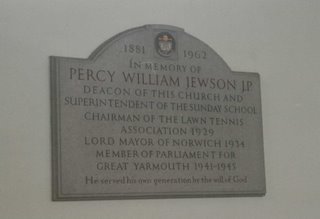
Take for example, the recent merger that resulted in the formation of Norwich Central Baptist Church. NCBC occupies the site of a historically prestigious local church whose foundation goes back to pre-enlightenment times; 1669, in fact. Before its recent renovations, the walls of the church were graced with paintings, old photographs and memorial stones celebrating the lives of past Baptist grandees and their positions both in church and society (See photos). Some members of the newly formed NCBC, however, felt uncomfortable with the rather starkly formal surroundings of the 1950s built church. My guess is that the display of solemn looking grandees and memorials was part of the problem. During renovations the pictures disappeared and there was even talk of removing the stone memorials. The bust of Joseph King-Horn, one of the church patriarchs, which dominated the Deacons room, also mysteriously disappeared. In fact a split in the vacated wooden base of the bust gives the appearance of it having been removed with some force! Although I don’t think this is actually the case, nevertheless, when I examined the empty pedestal I was sharply reminded of the broken stone to be found in the empty niches of medieval churches that suffered at the hands of zealous puritans! The comparison here may be a little strained, but one thing we can be sure of: once again the goal posts of religious perspectives are on the move and contemporary Christains no longer feel comfortable with the icons, images and expressive modes of a bygone time.


NCBC senses that the current cultural climate no longer favors the ecclesiastical and traditional trappings that encrusted the Baptist faith of the past. Church members seem non-plussed about the meaning of these overt and shameless displays of Baptist tradition and I can’t help but be reminded of the ruinous stone iconography of ancient Egypt whose power to invoke any sense of religious seriousness has long since gone because their mystique was bound up with their social context. Take a close look at the paintings and pictures of those Baptist patriarchs that once proudly hung on the walls of the Old Duke St. Baptist church: the demeanor and dress of these men signal anchorage, solidity, stability, tradition, experience, civic connection, scholarship, all of which seem inappropriate in fluid times of fast moving media images, disaffection and societal changes capable of rendering a life time’s experience void. Moreover, this religious memorabilia harks back to an era that had more confidence in secular government and was proud of civic status. Contemporary government no longer presumes a consensus and has more the character of a collection of pressure groups whose raison-d’etre of agitation are found in the fragments of postmodernism’s ‘little narratives’. In that process churches have become yet another marginal pressure group, often alienated from the secular civic authorities that once had a Christian gloss. Churches are therefore less able to identify with government and less willing to celebrate their civic connections, unlike their Christian predecessors.
As it is with the fragmentation of governmental vision so it is with theoretical visions. Grand narratives, like grand authorities, are taken as a sign of didactic presumption. These days you don’t let on if you have an all-embracing theoretical vision giving you the where-with-all to comment on anything, because that just comes over as intellectual hubris. The Postmodern vision does not accept that we live in a world sufficiently coherent to allow that sort of thing - the miracle of a cognitively integrated world is “pie in the sky” (Ironically that is precisely what it is!). Thus do churches feel uncomfortable with a confident modernist approach and they tend to make concessions to the ambiguities, diffidence, and downright nihilism of the day. The contemporary church is unlikely to make much of its claim to being the steward of an all-embracing theoretical cosmic vision and instead sells its feminine caring side, making show of primeval human traits such as relationship, love, music, feeling, adoration, and personal connection. These are values that few would dare to gainsay, as they seem to be the last bastions of humanity as the cold of a heartless cosmos seeps in. Not for the first time in history, then, there is a swing toward a touchy-feely romanticism in reaction against the hell like vision of an unfeeling machine world. At its most extreme this retreat into one’s humanity takes the form of a gnostic conversion to spiritual mysticism and fideism, a conversion that makes the recipient open to exploitation by shamanistic authoritarian demigods such as we find in the charismatic cults. It is surely an irony that those rather stuffy looking but scholarly genteel Baptist patriarchs, often vilified for being six feet above contradiction in their high pulpits, should now be replaced by apostles of anti-reason who take a dim view of so much as a probing question, let alone contradiction, and demand an unthinking fideism that rubbishes any investigation of their work as a sign of the unbelief of man’s reason.

Traditional ways are often discarded like outdated clothing and sometimes with the affected abhorrence that pubescent offspring show toward their parent’s styles and outlook. True, there is wisdom in this reaction in as much as it refreshes outmoded practices and language. But injustice is done if this also entails a forgetfulness of the past and a failure to acknowledge the good work of those who have gone before. I am not arguing for the formal portraits and Kinghorn’s bust to be prominently and dominantly displayed at NCBC – times have changed and we are here to serve the present and not the past. However, I can’t help but be suspicious of the motives behind the quiet disappearance of certain historical artifacts from NCBC. Does it betray a failure to come to terms with our past? Churches are often uncomfortable with one another and may even be alienated from each other (See previous post) so it comes as no surprise if churches are alienated from their own histories. In fact they often haven’t come to terms with some of their own members; there is sometimes a gap between an aspired church self-image and what is actually the case, and this can lead Christains to turn on one another demanding that they conform to this or that blessing, this or that renewal, this or that doctrine, this or that church structure, this or that preacher man, this or that prophecy, or this or that style of worship.

As for those old Baptist grandees, their own iconography has done them an injustice – they come over to us as anachronisms, static museum pieces conveying a message that can be misunderstood even by Christains. But rather than contemplate their dusty memorials it is much better to read their words in, for example, back copies of the church magazine, “The Messenger”. It is then that one starts to come into contact with their personalities and one is then left in no doubt about their faith. They successfully carried the flame for a while: as one Christian Blogger has put it using the words of another, if eccentric, giant of faith: “We stand on the shoulders of (the) giants (of faith).” They were spiritual, even if we despise their memorials. But I suppose our opinion of them doesn’t really count. If they worked well, their work will remain long after we have gone and will outlast even their stone epitaphs. Let us pray that our work will also stand the test of eternity. (1 Cor 3:11-15).


Joe Kinghorn: Gone to the great free lunch in the sky.

Monday, November 20, 2006

MIRROR, MIRROR.....
Norwich Central Baptist Church is part of a phenomenon I have called the “Wensum Valley Churches”. These are a group of protestant churches that huddle around an ancient meander in the Norwich Wensum valley and I list them as follows:

Norwich Central Baptist Church (conservative), Surrey Chapel (orthodox), Silver Road Baptist (Traditional?) Zoar Chapel (Strict and Particular), JW Kingdom Hall (Cult), Wensum Chapel, now City church (Charismatic), The Octagon chapel (Traditional), Princes Street UR (Traditional). The Cathedral (Traditional). St. Augustine’s (Emerging/postevangelical church), St Luke’s (Postevangelical/emerging church),

Stretching the line a little one might also include “Potters House” (Charismatic Cult) on Dereham road, St Barnabus (traditional) and even Kings Church (Charismatic). Tell me if you think I should add anymore to the list. This is a phenomenon I am still studying, classifying and describing, and so I’ll appreciate any input. Some of my labels may be non-distinctions e.g. it is questionable if there is much difference between the ‘conservative’ NCBC and the ‘orthodox’ Surrey Chapel. However, I want these two labels hanging around just in case I should at some date need to fine-tune my categories. Some of the categories actually overlap. Take a good look at this group of churches – they are perhaps just as diverse as the seven churches of Asia minor (Revelation 2ff); this group of churches sprawl over the best part of the Protestant spectrum.

I have attempted to classify these churches by introducing a classification scheme that is not based on doctrine but has more to do with “style” than “content” (although style and content are often well and truly conflated) One can, in fact, find similar differences of ‘style’ in Judaism: - e.g. Judaism has the equivalent of ‘orthodox’, ‘charismatic’ and ‘cult’ styles. The generality of this taxonomy does suggest that factors, not uniquely Christian, are at work here to produce these variants. Something else must unite distinctly Christian churches, something far more fundamental than just how orthodox, gnostic, traditional or progressive churches are. For me it is easy to identify what it is: Truly Christian churches understand that their faith and anointing (of 1 John 1:23&27) are void unless underwritten by the ultimate sacrifice made by God Himself, in Christ. But having said that one has to admit that some of the above churches have adopted novel doctrines and idiosyncrasies that threaten the very core of this inclusive faith. However, for those churches who do grasp the Truth, the Truth that gives purpose to life, the universe and everything, they are united by one faith, one baptism and one spirit, in spite of themselves, whether they like it or not. You don’t choose your blood relatives – and by ‘blood’ I mean “Christ’s blood”.


Churches of Norwich look at your selves in the mirror! Don’t be tempted to admire your self or drift off into a narcissistic reverie of self-praise, discounting “all them other churches” as your spiritual inferiors or even apostate! Look in the mirror and see what you really are: You cannot dissociate yourselves from one another: from the outside you all look to be part of the same untidy theme of history, a rough and ready hodge-podge of sometimes ‘anointing denying’ people, a people whose religious elaborations piggy-back on a core faith. There are those churches amongst us who still hanker after a propriety branding of all other churches after their own image, and whose fragile sectarian conception of faith identifies the ecclesial remnant with just another tiny purist splinter group of no cosmic significance whatever, here today and gone tomorrow. Instead Christianity, in actual fact, has cut a broad fuzzy variegated swathe through history, a swathe that sometimes includes some very uneasy partners! We must strive for a robust historical conception of church that mirrors the real state of affairs we find both in Norwich and else where. This is the Open Gospel.

But the Open Gospel is not just a new fangled idea of information and systems theory: In their heart of hearts all true Christians know it:

Though with a scornful wonder
Men see her sore oppressed,
By schisms rent asunder,
By heresies distressed:
Yet saints their watch are keeping,
Their cry goes up, “How long?”
And soon the night of weeping
Shall be the morn of song!

One foundation yes, but a complex sometimes-tacky superstructure! (1 Cor 3:1-15!)

Tuesday, October 24, 2006

CHAUVINIST'S CORNER

Political incorrectness has been all but banished from our church, especially in the matter of the equality of the sexes. But that hasn’t stopped us using music from Newfrontiers. Newfrontiers? What’s wrong with them? Their music is good and it’s theologically sound? I am sure it is, but it comes from a stable that the liberal minded may find just a teensy weensy bit tainted with patriarchy.

Newfrontiers came out of the late seventies restorationist movement, a movement whose “apostolic” father was Arthur “I learnt it in the Army” Wallis. In the summer 1979 issue of the Restoration magazine Wallis wrote of the role of women in church:

“Man’s head is Christ, so that in submission to Christ he receives authority from Christ. Women’s immediate head, however, is man, so she acts under man's authority”

Newfrontiers have mellowed since those heady days of rapid sideways growth of the Restorationist movement and now assume what they call a complementarian position on women. But according to Wikipedia, this means:

“… that women are not able to occupy positions of governmental leadership within the local (or wider network of) churches, such as eldership or apostolic ministries…”

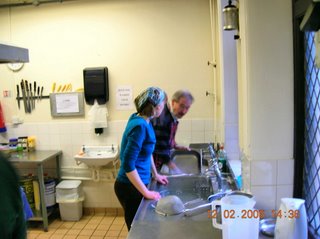
So there you go girls, it's back to your place by the kitchen sink. But judging from the snaps I took below of our politically correct dual ‘his and hers’ sink system it is precisely at the kitchen sink where NCBC is getting most flack from the “weaker sex”. It looks to me that we could do with a little bit of help from the Newfrontiers patriarchs. I wonder what their remuneration rate is for a Sunday sermon: pretty steep I should imagine as many of them were in high flying jobs as management consultants at some point. And what do we get? An RE teacher and a guy who lives with a cat called Lily.
*
Peter: Being a girl, Jo, I am sure there is nothing you like better than a bit of washing up and wouldn’t mind doing my sink as well.
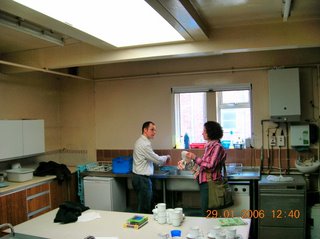
Jo : Being a boy, Peter, I am sure there is nothing you like better than a bit of car mechanics and wouldn’t mind changing a slashed tyre on your car before you go home.

Jo Westwood? More like “Jo Wayward”
*
Andy: Don't look now Debbie, but someone's taking a photo.
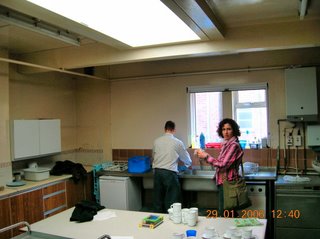
Half a second later: Speak to yourself Andy.
As you can see these two attempts by church elders at 'covering authority' are about as effective as the Canutian school of tidal management.

Thursday, September 28, 2006